
Insomnia Treatment in Boston, MA
From the makers of Rise, one of the most downloaded sleep apps in the U.S.
Rise for Insomnia runs a structured CBT-I program inside the Rise app. Same protocol clinicians use, on your own pace, no waitlist.
CBT-I is the first-line treatment for chronic insomnia, recommended by the American College of Physicians and the American Academy of Sleep Medicine. Rise for Insomnia runs the protocol (sleep restriction, stimulus control, cognitive techniques, sleep hygiene) inside the same Rise app millions of people already use to track their sleep.
Most users see meaningful sleep improvement within four to six weeks. Available to adults in Boston and across Massachusetts, without the months-long wait that comes with most board-certified CBT-I clinicians.

What is Rise for Insomnia?
Rise is one of the most downloaded sleep apps in the U.S., used by millions of people to improve their sleep. Rise for Insomnia is the part of the Rise app that runs a structured, clinical-grade CBT-I program for adults dealing with chronic insomnia.
CBT-I is the first-line treatment for chronic insomnia, recommended ahead of medication by the American College of Physicians and the American Academy of Sleep Medicine. The Rise app makes that protocol accessible to adults in Boston and across Massachusetts, on your own schedule and without a months-long waitlist for a board-certified clinician.
Most users see meaningful sleep improvements within four to six weeks.
At a glance:
- Built on the same CBT-I protocol behavioral sleep medicine clinicians use
- Lives inside the Rise app, alongside the same sleep-tracking and circadian tools millions of people already use
- Self-paced, so it bends to shift work, travel, and schedules that aren't 9 to 5
- Same-day start, no waitlist, no insurance pre-authorization
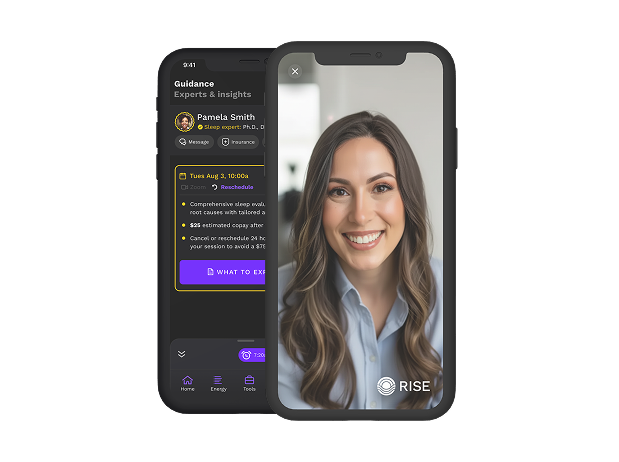
“For the first time, I had a safe place to talk about why I wasn't sleeping and someone who could show me exactly how to fix it. By improving my sleep, positive changes in the rest of my life just started stacking up.”
Who this treatment is for
You may be a good fit for the RISE Sleep Clinic if you:
- Take a long time to fall asleep
- Wake up during the night and can’t get back to sleep
- Wake earlier than you want
- Feel anxious or frustrated about sleep
- Have struggled with insomnia for months or years
CBT-I is designed to treat the root causes of insomnia — not just the symptoms.
“I wish more people knew about this. I can finally sleep better without a cocktail of medications every night.”
How insomnia treatment works
A structured, proven approach. Delivered through your phone.
Take a short sleep assessment
Answer a few questions about your sleep history. Your answers shape the CBT-I plan you start with, so the program isn't generic from day one.
Start the program in the Rise app
Begin the same day. The app walks you through CBT-I (sleep restriction, stimulus control, cognitive techniques, sleep hygiene) one step at a time.
Track sleep nightly, adjust weekly
The app uses your real sleep data to adjust your plan as you go. That's how a clinician would work in weekly sessions, except your data is continuous instead of recalled.
Build skills that last
Most users see meaningful improvement within four to six weeks. CBT-I is a time-limited course of care, not open-ended therapy. You finish, you keep the skills.
Takes just a few minutes. No obligation.
Why virtual sleep therapy works
Virtual CBT-I delivers the same evidence-based insomnia treatment as in-person care — with fewer barriers.
- Comparable outcomes to clinician-led care in published studies
- No commute, no waiting rooms, no scheduling around appointments
- Built with behavioral sleep medicine experts and sleep researchers
- You practice the techniques in your own bedroom, where insomnia actually happens
- Adjusts nightly based on your real sleep data
- Same-day start, regardless of where you live
The protocol is the same. The access barriers go away.
How the Rise app delivers your treatment
Rise for Insomnia lives inside the same Rise app that millions of people already use to track sleep. Inside the app, the CBT-I program runs alongside the circadian-rhythm and sleep-tracking tools that make Rise one of the most downloaded sleep apps in the U.S. The clinical protocol and the everyday tracking tools work together rather than in separate places.
Inside Rise for Insomnia you get:
- A structured CBT-I program: sleep restriction, stimulus control, cognitive techniques, sleep hygiene
- Nightly sleep tracking that adjusts your plan as you go
- Personalized timing recommendations based on your circadian rhythm
- Progress you can see week over week
The program is time-limited. You complete it, keep the skills, and the everyday Rise sleep tools stay with you afterward.
“I feel like I finally understand the way sleep works and more importantly, how to make it work for me.”
What to expect from treatment
- A structured CBT-I program you complete at your own pace, typically across four to six weeks
- Daily check-ins and nightly sleep tracking, no weekly appointment to schedule
- Plan adjustments driven by your real sleep data instead of session recall
- Built-in support for the things that throw sleep off: travel, stress, shift work, schedule changes
- Practical tools and skills you keep using after the program ends
No guesswork. No waitlist. No trial-and-error sleep hacks.
Why Rise for Insomnia makes sense in Massachusetts
CBT-I is the first-line treatment for chronic insomnia, but accessing it through a board-certified clinician in Massachusetts is genuinely hard. The supply gap is real, and it isn’t unique to Rise:
board-certified behavioral sleep medicine clinicians serving Massachusetts.
typical wait from intake to a first CBT-I session at academic and community sleep clinics in the state.
typical out-of-pocket cost for a full course of CBT-I when insurance doesn’t reimburse, or your provider isn’t in network.
Rise for Insomnia uses the same CBT-I protocol clinicians do, runs through the Rise app, and skips both the waitlist and the cash-pay sticker shock.
Figures are drawn from the Society of Behavioral Sleep Medicine member directory (MA state listings), MA academic/community sleep-clinic scheduling disclosures and published BSM-access literature (JCSM 2024), and prevailing Boston-market private-pay psychotherapy rates ($150-250/session over a typical 4-8 session CBT-I course plus intake).
Frequently Asked Questions
What is Rise for Insomnia?
Do I need to live in Boston to use Rise for Insomnia?
Is the program as effective as seeing a sleep therapist?
How quickly can I start?
Why isn't the Rise Sleep Clinic available with a clinician in Massachusetts?
How is Rise for Insomnia different from a sleep app like Calm or Headspace?
What if I want to see a CBT-I therapist in person instead?
Is the Rise Sleep Clinic the same as Rise for Insomnia?
What makes Boston challenging for sleep?
Boston has some of the best sleep medicine in the country and a daily rhythm that works against rest anyway. The commute averages 30.3 minutes, the economy runs on hospital and lab shifts, and getting a CBT-I clinician can mean a months-long wait.
- Long, transit-heavy commutes: Boston workers average a 30.3-minute commute versus 26.4 minutes nationally, and only about 33% drive alone. Roughly 23% ride the MTA or Commuter Rail, where delays make arrival times unpredictable and push back the evening wind-down.
- A round-the-clock hospital and biotech economy: Healthcare and life sciences are among Boston's largest employers, and the teaching hospitals and labs run overnight and rotating shifts. Working against the body's clock is one of the most reliable ways to develop chronic insomnia.
- Specialist access despite the density of clinics: Beth Israel Deaconess, Brigham and Women's, Mass General, and Boston Medical Center all run AASM-accredited sleep programs, yet board-certified CBT-I clinicians are scarce and new-patient waitlists at the academic clinics often run several months.
- Short winter days and dense housing: Boston gets close to 9 hours of daylight at the December low, and much of the city lives in triple-deckers and older apartments where street and neighbor noise carry. Less morning light and more nighttime noise both fragment sleep.
None of this is a personal failing; it is the city's schedule, geography, and winters stacked together. CBT-I works by retraining the behaviors and thoughts that keep insomnia going, regardless of your shift or your commute. Rise for Insomnia runs that protocol inside the Rise app, so you can start on your own schedule without waiting months for a Boston clinic to call back.
Other insomnia treatment options in Boston
For your reference, here are other sleep medicine facilities in the Boston area. This is provided for informational purposes only.
Beth Israel Deaconess Medical Center Sleep Disorders Center
Brigham and Women's Sleep Disorders Service
Massachusetts General Hospital Division of Sleep Medicine
Boston Medical Center Sleep Disorders Clinic
Disclaimer: The facilities listed above are independent healthcare providers. RISE has no affiliation with these organizations. This information is provided for reference only and does not constitute an endorsement or recommendation. Please verify all information directly with the facility.
Also Serving Nearby Cities
Ready to start sleeping better?
If you've tried sleep tips, supplements, or medication and you're still not sleeping, CBT-I is what the research keeps pointing to. Rise for Insomnia runs that program inside the Rise app, on your own schedule, with no waitlist.
Start Your Assessment