
CBT-I apps work. Two of them are FDA-cleared and need a prescription — Sleepio and Somryst — and the free ones, led by the VA's CBT-i Coach, have real evidence behind them too. What a clinician adds is the fit check: whether an app is the right treatment for you, or whether something else is keeping you awake.
Yes, and the evidence is better than most people expect. A six-week fully automated program with no therapist reached 56.6% remission at one year in a randomized trial of 303 adults, half of whom had a medical or psychiatric condition alongside their insomnia. Across 20 randomized trials of self-help CBT-I, the 14.5% dropout rate was no different from the 16.7% seen with therapist-delivered CBT.
Across 11 trials of internet-delivered CBT-I, effects were comparable to face-to-face care, and in that same analysis more personal clinical support tended toward larger effects. Both halves of that belong together: software alone genuinely treats insomnia, and human contact is one of the things the numbers responded to.
Three things, and none of them is a relaxation soundtrack. It collects a sleep diary, because every decision in CBT-I comes from your own numbers. It uses those numbers to set a sleep window, which is sleep restriction. And it gives you the stimulus control rules, the ones about getting out of bed when you are lying there awake.
Sleep hygiene tips are the part people expect, and the part that carries the least weight: the AASM guideline suggests clinicians not use sleep hygiene as a single-component therapy for chronic insomnia. An app whose whole offering is a checklist of hygiene habits is not a CBT-I app.
Two, and both need a prescription. The FDA has a device category for this — "computerized behavioral therapy device for insomnia" — and exactly two products sit in it: Sleepio, cleared in August 2024, and Somryst, cleared in March 2020. Everything else you can download is unregulated, which does not make it useless, but does mean nobody checked it.
Not to gatekeep it. The clinician is doing the thing an app cannot do for itself: checking that insomnia is actually your problem.
No app screens you for sleep apnea, and untreated apnea is the common reason a sleep window stops working. Pregnancy changes what is appropriate. So does a psychiatric condition, or chronic pain, or a medication you are already taking. A self-picked app skips all of that and starts compressing your time in bed anyway. That is the difference between an app that might help and a treatment someone confirmed was right for you.
They are worth taking seriously, and CBT-i Coach is the one to know. It is free, carries no ads, is open to anyone rather than only veterans, and it was built by the VA with Stanford and the VA Palo Alto health care system.
Its design intent gets lost in most recommendations: it was made as a companion to a course of therapy, and its randomized pilot enrolled only patients who were already receiving CBT-I. Using it alone stretches what it was built for. There is evidence for solo use — an 18-month study of 1,618 public users found insomnia symptoms improved with a moderate effect size of 0.57 — but that study had no control group, so it is not an efficacy estimate.
If cost is the binding constraint, a free program with published evidence is a serious option. Given a choice between a paid program you will not start and a free one you will, start.
Ask whether it does the two things that carry the evidence. Does it take a sleep diary and set you a sleep window that changes as your sleep consolidates? And does it give you stimulus control instructions rather than a list of habits? If the answer to either is no, it is a sleep-hygiene app with CBT-I in the description.
After that, ask what happens in week two, when the schedule is working and you feel worse. An app that has no answer for that question is the one you will delete.
Most of what people want to fix about their sleep does not need a clinic. The RISE consumer app is built for that: it models your sleep debt against your own sleep need and your circadian rhythm to help you manage your sleep, your energy through the day, and the habits that move both. It is not itself CBT-I.
The RISE Sleep Clinic is for people who need more than better sleep management — insomnia that has become chronic and stopped responding to good habits. It starts with a sleep intake — your sleep patterns, symptoms, health and lifestyle. A licensed clinician reviews it, decides whether CBT-I is a clinical fit, and verifies your insurance coverage. If it is, they help you get set up with Sleepio (prescribed as SleepioRx). And you are never on your own with software — a licensed sleep psychologist is a video call away whenever you want to talk something through: a question, a rough patch, or the full 1:1 course. If the digital route alone is not moving your nights, that is the signal to add the clinician.
So "which app should I get?" and "do I need a clinician?" turn out to be the same question, and the intake answers both at once. If a free app is what is reachable for you today, the evidence above says that is a reasonable place to start — and you can talk to the RISE Sleep Clinic when you want the prescription route or the clinician half.
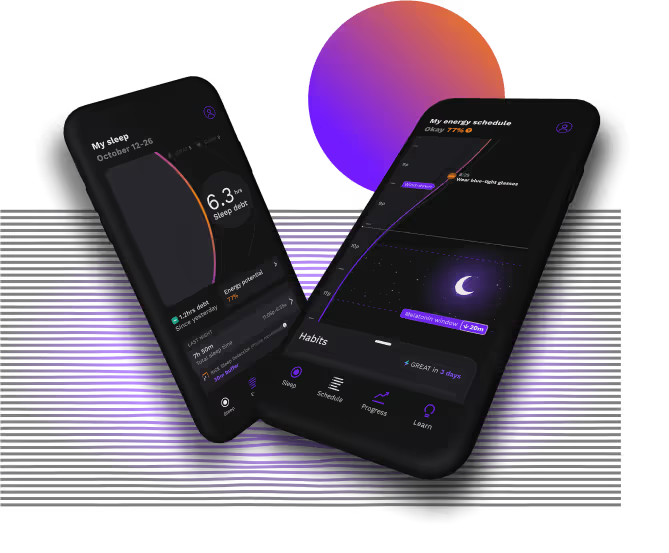
RISE makes it easy to improve your sleep and daily energy to reach your potential


CBT-i Coach is. It's published free by the U.S. Department of Veterans Affairs, carries no ads, and is open to anyone rather than only veterans. The two FDA-cleared programs, Sleepio and Somryst, are prescription products, so what you pay depends on your plan rather than on an app store price.
There's no trial ranking them against each other. Two are FDA-cleared and need a prescription: Sleepio, cleared in 2024, and Somryst, cleared in 2020. CBT-i Coach is the free option with published evidence. Judge any other app by mechanism — a sleep diary, a sleep window that changes, and stimulus control rules.
Two are FDA-cleared, which is the correct term for this device category. Sleepio was cleared in August 2024 and Somryst in March 2020, both as computerized behavioral therapy devices for insomnia. Both need a prescription from a licensed provider. Everything else you can download is unregulated — not necessarily bad, just unchecked.
Sort of — and there's a better version of "on your own" than a workbook. A fully automated program reached 56.6% remission at one year in a randomized trial, and self-help dropout matches therapist-delivered CBT. The stronger self-directed route is a prescription program: a clinician confirms it fits, then you work it on your own schedule.
Probably, though the evidence for solo use is thinner than for guided use — the research is thinner, not necessarily the app. An 18-month study of 1,618 public users found symptoms improved with a moderate effect size of 0.57, with no control group. Its randomized pilot studied it as an adjunct in patients already receiving CBT-I.
Because someone has to check that insomnia is the right diagnosis first. No app screens you for sleep apnea, which is a common reason a sleep window stops working, and pregnancy, psychiatric conditions and chronic pain all change what's appropriate. The prescription step is that fit check, not a paywall.
When an app's schedule hasn't shifted anything after several weeks, when your insomnia has run three or more nights a week for three months, or when something else may be going on. You don't have to choose up front — one intake, and a clinician matches you to the app route, sessions, or both.