

Sleep debt is the sleep you owe your body — the gap between your individual sleep need and how much you've slept recently. It is not measured against a generic eight hours. Looking at data from 1.95 million RISE users aged 24 and up, almost half need eight hours or more.
Sleep debt is the running shortfall between the sleep you need and the sleep you've gotten lately. It is not sleep that vanishes forever. And it is not a stash you can fully bank before a late week.
Your sleep need is individual. One study put the mean optimal sleep duration at eight hours 25 minutes, with a range from about seven hours 17 minutes to nine hours 16 minutes. Looking at data from 1.95 million RISE users aged 24 and up, sleep needs range from five hours to 11 hours 30 minutes. The median sleep need was eight hours, but almost half of our users need eight hours of sleep or more a night. That is why a generic eight-hour target can leave you short, or send you to bed earlier than you need.
We split the idea into two windows:
Sleep scientists treat acute debt as the number that best predicts how you feel and perform today. You do not need a sleep score to act on it. Duration against your need is the useful measure.
What it is not:
“Sleep debt is the amount of sleep you've lost out on recently,” says Dr. Chester Wu, a double board-certified doctor in psychiatry and sleep medicine. “It will keep building up all the time you're not getting enough sleep. But you can pay back short-term sleep debt to boost your energy levels and performance.”
Sleep debt is calculated by subtracting the sleep you've gotten from the sleep you need, then adding that gap across recent nights.
If you need eight hours 10 minutes and you sleep seven hours, that night adds one hour 10 minutes. If you keep falling short, the total grows. If you sleep longer than your need, the extra time pays some of it down.
That is the idea. The RISE method, stated openly, is a product choice, not a published formula. We roll the gap over 14 nights. Last night carries 15% of the weight, because it has the largest effect on how you feel today. The other 85% comes from the 13 nights before that, with more recent nights weighted more heavily.
Van Dongen showed why debt accumulates as extra wakefulness with a neurobiological cost. Kitamura showed why need is individual. The 14-day window is how RISE turns those findings into a number you can track.
You cannot do this accurately from memory. People mis-estimate how much they sleep. And you may not know your need. We cover how much sleep you need separately. You can also run a simple estimate with the sleep debt calculator.
Here is a worked example. The person needs eight hours 10 minutes. The running total is a simple sum of nightly gaps over 14 nights, so you can see the math. RISE's live number weights recent nights more, so it will not match this table to the minute.
| Night | Sleep obtained | Nightly gap vs 8h 10m need | Running 14-day debt |
|---|---|---|---|
| 1 (Mon) | 7h 00m | −1h 10m | 1h 10m |
| 2 (Tue) | 6h 30m | −1h 40m | 2h 50m |
| 3 (Wed) | 7h 20m | −0h 50m | 3h 40m |
| 4 (Thu) | 8h 00m | −0h 10m | 3h 50m |
| 5 (Fri) | 7h 00m | −1h 10m | 5h 00m |
| 6 (Sat) | 9h 00m | +0h 50m | 4h 10m |
| 7 (Sun) | 8h 30m | +0h 20m | 3h 50m |
| 8 (Mon) | 7h 00m | −1h 10m | 5h 00m |
| 9 (Tue) | 6h 45m | −1h 25m | 6h 25m |
| 10 (Wed) | 7h 30m | −0h 40m | 7h 05m |
| 11 (Thu) | 8h 10m | 0h 00m | 7h 05m |
| 12 (Fri) | 7h 15m | −0h 55m | 8h 00m |
| 13 (Sat) | 9h 20m | +1h 10m | 6h 50m |
| 14 (Sun) | 8h 45m | +0h 35m | 6h 15m |
By night 14, this person is carrying about six hours 15 minutes of simple running debt. Weekend catch-up chipped away at it. It did not wipe the week. That is the usual pattern — a little extra on Saturday does not erase five short weeknights.
Sleep debt can slow your thinking, sour your mood, and, if it stays high for years, is associated with later health problems.
The size of the gap matters. In a 14-day restriction study, people limited to four or six hours in bed showed dose-dependent lapses in attention. By the end, those deficits looked like one or two nights of total sleep loss. Subjects were largely unaware of how far their performance had fallen.
A week of about five hours a night produced escalating lapses, mood disturbance, and sleepiness. Recovery appeared to need two full nights. Even then, not every measure bounced back in every study.
This is why you can feel “fine” on too little sleep. Circadian alerting can mask chronic debt during the biological day. The deficit tends to reappear at night. You have not adapted. You have stopped noticing.
Day to day, acute debt is linked to:
Over years, habitual short sleep is associated with more than a rough Monday. An Institute of Medicine review linked chronic short sleep to hypertension, diabetes, obesity, depression, heart attack, and stroke. A 25-year follow-up of the Whitehall II cohort found that five hours or less at midlife was associated with later multimorbidity, compared with about seven hours. Those are associations, not proof that last week's debt caused a disease.
A review of chronic restriction also describes hits to cognition, metabolism, and immunity. How hard you feel it varies. Some people tolerate short sleep better than others. That tolerance is not the same as your sleep need, and it is not a free pass.
At RISE, we recommend you keep acute sleep debt below five hours. Mental performance with about five hours of deficit can sit close to zero. Zero is great. It is also a stressful target if you start watching every lost minute. And stress then keeps you up, which adds more debt.
You can repay short-term sleep debt by sleeping longer than your need, but recovery is slower than the nights you lost, and it is not complete for every system.
A 2016 recovery study found one hour of potential sleep debt takes about four days of extended sleep to recover. A real-world study that included Rise advisor Dr. Jamie Zeitzer found that, on average, it takes three nights to make up one insufficient night of sleep.
The nuance sits in what “repay” means.
After seven days of three, five, seven, or nine hours in bed, three recovery nights of eight hours did not fully restore the three-hour and five-hour groups. After five nights of four hours in bed, even about 10 hours in bed for one night did not fully restore attention, sleepiness, or fatigue. A week of mild restriction followed by three long nights reversed sleepiness and some stress hormones, but psychomotor vigilance did not.
Weekend catch-up is mixed in the same way. In adults under 65, short weekend sleep was associated with higher mortality, while weekday-short plus weekend-long did not differ from a six-to-seven-hour reference. A 2023 observational paper found weekend catch-up associated with a lower high-cholesterol risk than no catch-up. Pair that with Depner: extra weekend sleep may help some outcomes and still leave metabolism partly unrestored.
A 2023 review of recovery dynamics makes the practical point. Mood, sleepiness, and cognition recover at different rates. Acute loss and chronic restriction do not unwind on the same clock. Weekend catch-up does not fully restore function.
The American Academy of Sleep Medicine says adults should sleep seven or more hours. Sleeping more than nine hours may be appropriate when you are recovering from sleep debt. That “or more” is the recovery clause.
How to chip away at it, without blowing up your circadian rhythm:
We've covered the full recovery case in can you catch up on sleep, and the timeline in how long recovery takes.
“You can pay down short-term sleep debt, but do it with slightly longer nights, not one heroic weekend,” says Dr. Wu. “If you still cannot get close to your need after a couple of weeks of earlier bedtimes and decent sleep habits, talk to your doctor. Something else may be in the way — insomnia, sleep apnea, or a schedule you cannot fix alone.”
Sleep debt is the hours you owe. Sleep deprivation is the state of not getting enough sleep. They overlap. They are not the same term.
Debt is a running measurement against your need. Deprivation is the condition that measurement describes — and the lab protocol used to study it. Van Dongen compared chronic restriction with total sleep deprivation and found that days of short sleep can cost as much, on attention tests, as a night or two of no sleep at all.
People also mix debt with a sleep deficit, sleep restriction, and sleep-deprivation stages. In practice:
Sleep debt is not a formal disorder. You will not find it as a diagnosis. It is still a useful way to talk about a real, measurable gap.
To measure your sleep debt, you need two numbers: how much sleep you personally need, and how much you've slept over the last two weeks.
Start with need. Population guidelines sit at seven or more hours for adults, or a seven-to-nine-hour band. Those are floors and ranges, not your number. Eight hours is the median in our user base, not a rule. Forty-eight percent of users need eight hours or more. Use the sleep need guide if you are estimating by hand.
Then log recent sleep. Bedtime and wake time are enough for a rough estimate. Time in bed is not time asleep, so this will be slightly generous. Run the nights through the calculator below, or on the standalone sleep debt calculator page. We've also written a longer walkthrough of how much sleep debt you have.
Two caveats. First, you adapt to the feeling of debt faster than to the performance cost. Feeling “used to it” is not a measurement. Second, a wearable sleep score collapses the wrong variables. Track duration against your need, and keep your sleep-wake times aligned with your body clock. RISE users with low sleep debt have more consistent sleep-wake times than those with high sleep debt.
RISE estimates your need from a year of phone-use patterns and sleep-science models, then compares that need with the sleep you've been getting. The app updates the 14-day number each morning, so you can see it rise or fall as you change the nights.
Sleep debt calculator
Sleep debt is how much sleep you owe your body against your own need — not against a generic eight hours. Enter the last 14 nights, or a weekday and weekend average.
Estimated sleep debt
8.1 hours
RISE tracks this against your actual sleep need, not a guess. Try RISE free
If the number is under five hours, you are in the range we aim for. If it is higher, pay it down with slightly longer nights — and protect the next week so you do not put it straight back on.
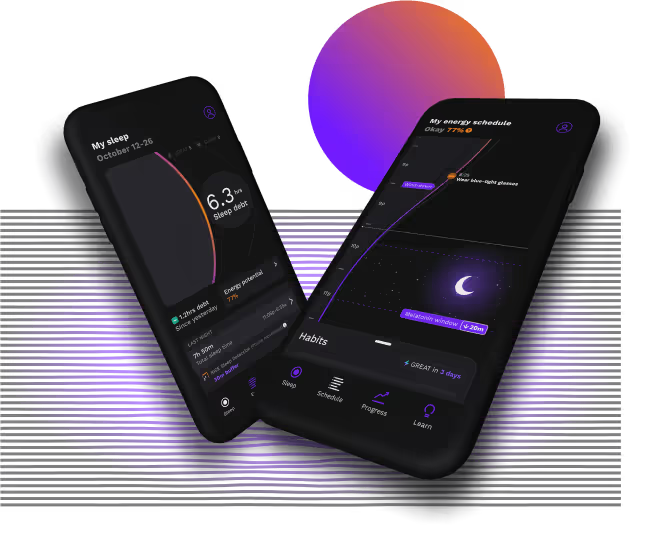
RISE makes it easy to improve your sleep and daily energy to reach your potential



Sleep debt is the amount of sleep you've missed recently, measured against your own sleep need. If you need eight hours and you get six, you add about two hours of debt that night. It keeps building while you fall short. Short-term debt can drag energy, mood, and focus. Long-term short sleep is associated with later health problems. RISE tracks this over 14 nights.
You can recover from short-term sleep debt by sleeping longer than your body usually needs. Naps, a slightly earlier bedtime, or a slightly later wake time can all help. Recovery is slower than the nights you lost. Kitamura et al. (2016) estimated that one hour of potential sleep debt takes about four days of extended sleep. Some measures, including attention and metabolism, may not fully rebound after a weekend of catch-up.
How long recovery takes depends on how much sleep debt you have and which system you measure. Kitamura et al. (2016) estimated that one hour of potential sleep debt takes about four days of extended sleep. Althoff et al. (2017) found that, on average, it takes about three nights to make up one short night. Mood, sleepiness, and cognition recover at different rates. Chronic short sleep takes longer than a few late mornings.
Weekend catch-up can chip away at weekday sleep debt, but it is not a full reset. Extra weekend sleep has been associated with some better health markers than no catch-up at all. It has also failed to prevent metabolic changes on the next short week. Keep weekend lie-ins to about an hour or two so you do not shove your body clock later. Slightly longer nights all week work better.
There is no official safe amount of sleep debt. At RISE, we recommend keeping acute sleep debt below five hours. Mental performance with about five hours of deficit may sit close to what it would be at zero. Zero is a fine goal. It can also become a stressful one if you watch every lost minute. Stress then keeps you up and adds more debt.
Sleep debt is the hours you owe against your sleep need. Sleep deprivation is the state of not getting enough sleep, and the lab protocol used to study that state. They overlap, but they are not the same term. If you want a number you can track, use sleep debt. If you want the clinical or research language for not enough sleep, that is sleep deprivation or sleep restriction.