

Sleeping pills work faster; CBT-I lasts longer. Both the American College of Physicians and the American Academy of Sleep Medicine recommend CBT-I first and reserve medication for a shared decision after CBT-I alone hasn't worked. In one trial, 44% to 63% of patients were still in remission two years after a six-week course.
Sleeping pills work faster, and it is not close. A prescription sleep aid can shorten the time it takes you to fall asleep on the first night you take it. CBT-I asks for a few weeks, and the first stretch can be the worst part of it, because a compressed sleep schedule builds pressure by making you sleepier before it makes you better.
The comparative review is careful about this. Across the randomized trials that put the two head to head, very low grade evidence suggests benzodiazepines are more effective in the short term, while low to moderate grade evidence favors CBT-I in the long term. Both halves of that sentence are real. Anyone selling you CBT-I as also faster is overselling it.
CBT-I, by a wide margin, and this is the whole case for it.
In a placebo-controlled trial that compared CBT, pharmacotherapy, and both, CBT produced the largest changes in sleep latency and sleep efficiency, yielded the most normal sleepers afterwards, and maintained its gains at long-term follow-up. Pharmacotherapy produced moderate improvements while the drug was being taken and returned measures toward baseline once it stopped. Combining the two gave no advantage over CBT alone.
The longest follow-up says the same thing further out. Two years after a six-week course, insomnia remission ran 44% to 63% across four treatment arms — and the arm that did best was the one where patients tapered zolpidem while continuing CBT-I, not the one where they kept taking it as needed.
Six measures, and the answer flips depending on which one you care about.
Yes, and plenty of people start that way. What the trials suggest is that the combination isn't the upgrade it sounds like. Adding medication to CBT gave no advantage over CBT alone in the placebo-controlled comparison, and in the two-year follow-up the patients who tapered off while continuing therapy did better than those who continued medication as needed.
The question is not really pills versus therapy. It is whether the medication is a bridge or a destination. Do not change or stop a prescription on your own — that's a conversation with the doctor who wrote it, and some hypnotics need a supervised taper.
Slowly, with a clinician, and ideally with CBT-I running alongside it. That combination has its own randomized trial: 65 older adults who had taken a benzodiazepine nightly for more than three months were assigned either to supervised gradual tapering alone or to tapering plus eight weekly group CBT sessions. Immediately after treatment, 77% of the combined group had stopped completely against 38% of the tapering-only group, confirmed by blood screening. At 12 months it was 70% against 24%.
The reason is not mysterious. Tapering removes the thing you have been relying on to sleep; CBT-I replaces it with something else that works. Take one away without the other and the insomnia is still there waiting.
If you are further back than a prescription — reaching for melatonin or an over-the-counter aid — melatonin is a circadian signal rather than a sedative, and we have written separately about how to sleep without sleeping pills and about the evidence behind natural sleep aids.
The ACP recommends that all adult patients receive CBT-I as the initial treatment for chronic insomnia disorder, graded strong on moderate-quality evidence. Its second recommendation — weak, on low-quality evidence — is that clinicians use shared decision-making about short-term medication for patients in whom CBT-I alone was unsuccessful. The AASM graded the behavioral treatments separately in 2021 and gave multicomponent CBT-I its only strong recommendation.
The full evidence picture, including where CBT-I falls short, is on whether CBT-I is effective.
Here the comparison turns against CBT-I. A prescription takes ten minutes; a course of CBT-I takes a referral to a specialty that may not exist near you. A geographic survey counted 659 behavioral sleep medicine providers in the United States, with 105 of the 167 cities over 150,000 people having none.
Virtual care is what closes that gap, and you can work with an insomnia therapist without one in your city. What you pay depends on your plan.
A hypnotic works on your brain; CBT-I works on your sleep pressure and your body clock. Sleep restriction concentrates the same drive that makes sleep debt worth measuring, and stimulus control stops your bed from being somewhere you practice lying awake. Neither of those effects has anything to switch off when you stop taking something, which is why the two-year numbers look the way they do.
Timing matters as much as pressure. The same hours in bed do less when they run against your circadian rhythm, and a pill won't move your body clock.
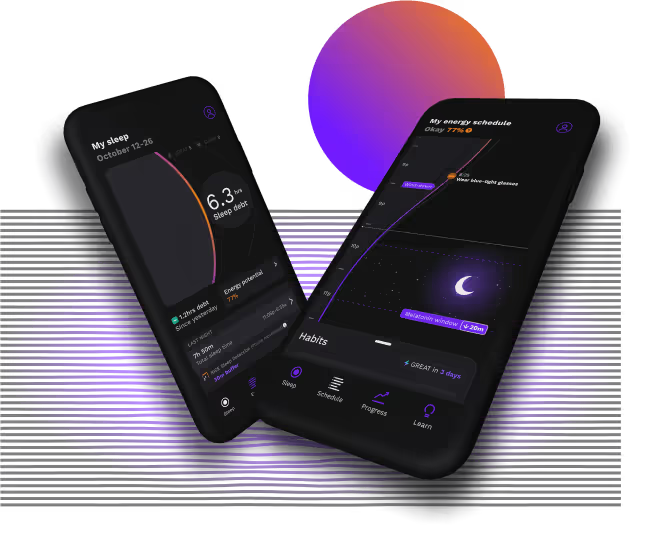
RISE makes it easy to improve your sleep and daily energy to reach your potential



Over months and years, yes. Low to moderate grade evidence puts CBT-I ahead of benzodiazepines and Z-drugs in the long term, and both major guidelines recommend it first. In the short term the drugs are faster, on very low grade evidence. The deciding difference is what happens after you stop.
Across 20 randomized trials, CBT-I cut sleep latency by about 19 minutes and time awake in the night by about 26 minutes, and raised sleep efficiency by roughly 10 percentage points. Total sleep time barely moved. In a comorbid-insomnia meta-analysis, 36.0% reached remission against 16.9% of controls.
You can, and many people begin that way. The trials suggest it isn't an upgrade: adding medication gave no advantage over CBT alone, and patients who tapered off while continuing therapy did better at two years than those who kept taking it as needed. Don't change a prescription without the prescriber.
In one randomized trial it roughly tripled the odds. Older adults on nightly benzodiazepines were assigned to a supervised taper alone or a taper plus eight CBT sessions. At 12 months, 70% of the combined group had stopped completely against 24% of the taper-only group, confirmed by blood screening.
They carry documented risks that CBT-I doesn't. Zolpidem, zaleplon, and eszopiclone have an FDA boxed warning for complex sleep behaviors — sleepwalking, sleep-driving — that can cause serious injury or death, and the FDA says they shouldn't be prescribed to anyone who has had such an episode. That's a conversation for your prescriber, not a reason to stop abruptly.
It depends what you count. In the comorbid-insomnia meta-analysis, 36.0% of patients were in remission after treatment against 16.9% of controls. In a two-year follow-up of a six-week course, 44% to 63% were still in remission. A 2026 review of 195 candidate predictors found no reliable way to forecast who responds.