

CBT-I is cognitive behavioral therapy for insomnia — a short, structured program that rebuilds your sleep drive and breaks the link between your bed and lying awake. The American College of Physicians recommends it as the initial treatment every adult with chronic insomnia should get, before sleeping pills.
CBT-I is a short program, usually six to ten weekly sessions, where a clinician uses your own sleep diary to change three things: when you’re in bed, what you do when you’re awake in it, and how you think about the night ahead. That last part matters because the 3 a.m. math about how ruined tomorrow will be is part of what keeps you alert.
What it treats is chronic insomnia — trouble falling asleep or staying asleep at least three nights a week for three months or longer, with daytime consequences. The American Academy of Sleep Medicine recommends multicomponent CBT-I for chronic insomnia in adults, and that is the only strong recommendation in its 2021 review of behavioral and psychological treatments. Every other recommendation in the document is conditional.
CBT-I is a package, usually described as five parts. How much evidence each part carries on its own varies, which is the argument for taking the package rather than picking a favorite piece.
Sleep hygiene is the one most people have already tried. The AASM guideline suggests clinicians not use it as a standalone treatment for chronic insomnia. It isn’t harmful and it isn’t wrong — it just doesn’t carry a course of treatment by itself, which is why fixing your sleep hygiene can leave a real insomnia untouched.
Two things separate it from talk therapy: it stays on one subject, and it ends. A course is about your sleep rather than your history, and it wraps up once the sleep has changed instead of continuing open-endedly.
It’s also prescriptive in a way talk therapy usually isn’t. Your clinician sets a bedtime and a rise time from your own diary numbers and asks you to hold them, including on the mornings you feel terrible. That’s why CBT-I gets described as hard rather than gentle: the first stretch of a compressed schedule can leave you sleepier, and that sleepiness is the pressure the schedule is built to concentrate. Sleep restriction has moderate-to-large effects on sleep latency, night waking, and sleep efficiency as a standalone therapy, and only a small effect on total sleep time.
The clearest single summary is a 2015 meta-analysis in Annals of Internal Medicine. Across 20 randomized trials and 1,162 adults with chronic insomnia, CBT-I cut the time people took to fall asleep by about 19 minutes, cut time awake during the night by about 26 minutes, and raised sleep efficiency by roughly 10 percentage points. No adverse outcomes were reported in any of the trials.
Total sleep time is the exception. Across the trials it grew by only about eight minutes — so little that the researchers could not rule out no gain at all. CBT-I does not add hours of sleep; it makes the sleep you already get hold together. That distinction matters if you’re measuring the wrong thing: a night that finally holds together in one piece feels different from a night with the same total broken into four.
Durability is the other half of the case. In a Université Laval trial that followed patients for two years after a six-week course, insomnia remission rates ran from 44% to 63% at 24 months. Patients who tapered off zolpidem while continuing CBT-I did better in the long run than patients who kept taking it as needed.
Insomnia rarely arrives alone, and the evidence covers that case too. A meta-analysis of 37 trials in JAMA Internal Medicine found that among people whose insomnia sat alongside a psychiatric or medical condition, 36.0% were in remission after CBT-I compared with 16.9% of controls — with the same exception for total sleep time.
Most people start seeing changes within a few weeks, and a standard course finishes in six to ten. The trial behind those two-year numbers ran an acute course of six weeks, and shorter versions exist — the AASM guideline gives multicomponent brief therapies a conditional recommendation of their own.
Expect the night to change before the day does. Sleep efficiency tends to move first, and the AASM’s own evidence review noted limited evidence that improved sleep produced clinically meaningful changes in daytime fatigue, even where the sleep gains were solid and well sustained. If several weeks of holding the schedule honestly changes nothing, that’s worth raising with your clinician rather than pushing harder. Untreated sleep apnea is a common reason CBT-I stalls.
All three work, and the choice is less about which is stronger than about which one you will actually do.
Video and in-person are the same treatment with the same kind of therapist, and a randomized noninferiority trial of 65 adults found that people treated over video did not do worse than people treated in the office — not right after treatment and not three months later — and they rated the relationship with their therapist about the same. App-based programs hold up too. In the largest placebo-controlled trial, 76% of the digital-CBT group finished treatment with sleep efficiency above 80% — meaning they were asleep for at least 80% of their time in bed — compared with 29% of people on a look-alike placebo program and 18% getting usual care.
Across 11 trials of internet-delivered CBT-I, effects were comparable to face-to-face care, and the people who had more human support tended to do better. So software alone treats insomnia, and a clinician raises the odds you finish and adjusts the plan when the standard one does not fit.
That leaves the practical questions: what it costs, how long you would wait for a provider, whether weekly appointments fit your life, how much human contact you want, and whether anything else is going on — pregnancy, another sleep disorder, a mental-health condition — that needs a clinician's judgment. RISE's answer is to not make you choose blind: one intake, a licensed clinician reviews it and recommends digital CBT-I, 1:1 sessions with a sleep psychologist, or both.
Ask your doctor for a referral to behavioral sleep medicine, or go direct to a provider. The practical obstacle is supply. A geographic survey counted 659 behavioral sleep medicine providers in the United States, with 105 of the 167 U.S. cities over 150,000 people having none at all, and four states having none. That shortage is a large part of why a treatment two guidelines call first-line gets prescribed less often than the medications it is recommended ahead of.
Virtual care is what closes that gap for most people. RISE runs a clinic for this specifically, so you can work with a sleep psychologist who delivers CBT-I, billed through major insurance plans. What you pay depends on your own plan.
Sleep restriction works on the same mechanism that makes sleep debt worth tracking: sleep pressure builds while you’re awake, and you can concentrate it or bleed it away. CBT-I concentrates it on purpose. Naps, long lie-ins, and an early bedtime after a rough night all bleed it away, which is why the obvious responses to a bad night tend to entrench chronic insomnia instead of clearing it.
Timing is the other lever. The same hours in bed do less for you when they sit against your circadian rhythm, and a schedule that ignores your body clock will keep asking you to sleep when your body is running its wake signal.
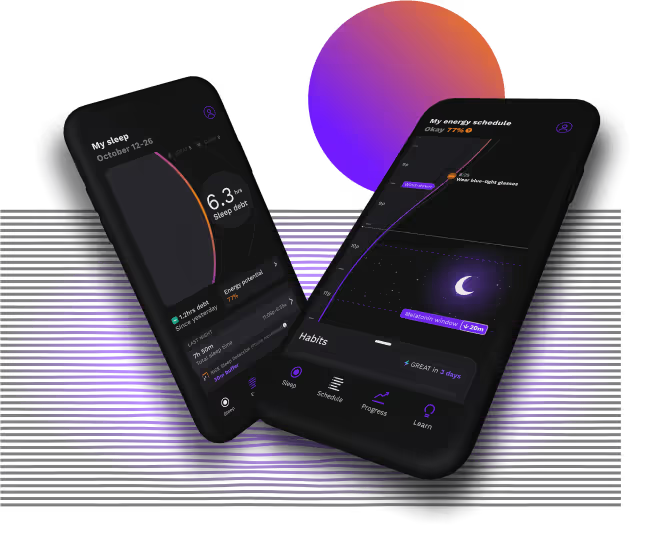
RISE makes it easy to improve your sleep and daily energy to reach your potential



Sort of — and there's a better version of "on your own" than a workbook. Self-guided programs have real evidence: internet-delivered CBT-I performed comparably to face-to-face care across 11 trials. The strongest self-directed option is prescription digital CBT-I, which a clinician orders after reviewing your intake and which you work through on your own schedule, with a clinical team behind it if you need to step up to 1:1 care.
Sleep restriction, stimulus control, cognitive therapy, relaxation training, and sleep hygiene education. The AASM's 2021 guideline suggests stimulus control, sleep restriction, and relaxation can each be used on their own, and suggests clinicians not use sleep hygiene by itself. Cognitive therapy is delivered inside the multicomponent package, which is the version the guideline recommends strongly.
Both major guidelines put CBT-I first. The ACP recommends it as initial treatment and reserves medication for a shared decision after CBT-I alone hasn't worked. The clearest difference is what happens after you stop: in one trial, remission held at 44% to 63% two years past a six-week course, and patients who tapered zolpidem while continuing CBT-I did better than those who kept it.
Often, yes. When a licensed clinician delivers it, CBT-I is usually billed as behavioral health rather than as a sleep product, so it goes through the same benefits as any other therapy visit. App-only programs with no clinician are a different case and frequently aren't covered. Your own plan decides your copay, so verify benefits before you start.
The first couple of weeks are the hard part. A compressed sleep schedule can leave you sleepier before it leaves you better, and holding a fixed rise time after a bad night takes some resolve. That's the mechanism rather than a side effect. Trials of CBT-I reported no adverse outcomes, and the schedule widens again as your sleep consolidates.
Yes. Most people in these trials had lived with insomnia for years themselves — chronic insomnia starts at three months, and the average participant in the largest meta-analysis was in their mid-fifties. What changes with duration isn't whether CBT-I works but how much structure helps: long-standing insomnia tends to do better with a full course and a clinician adjusting the protocol.