
Do sleep trackers work? They work well enough for sleep duration and timing. They do not reliably identify sleep stages. That gap usually does not matter for behavior, because paying down sleep debt and aligning with your body clock do not require stage labels.
They work for the part that changes tomorrow: how long you slept and when. They do not work as a bedside sleep lab.
If you bought a ring or a watch to learn whether you slept, you already have the measurements that matter most. Consumer devices are generally good at detecting that you fell asleep and when you got up. A 2024 lab comparison of five commercial trackers found total sleep time was close to research-grade actigraphy on most devices. Wake after sleep onset was the miss — mean absolute percentage error ran from 59% to 138%.
A 2021 comparison of seven consumer devices against polysomnography — the overnight lab study that reads brain waves — found the same pattern. Sensitivity for sleep was high. Specificity for wake was low. In plain language, the watch is better at calling you asleep than at noticing you woke up.
And that is still useful. Duration and clock time are what you need to see whether you met your need, whether you drifted later on weekends, and whether a 5:30 alarm is buying you extra debt. For the device-by-device numbers, see sleep tracker accuracy.
They measure sleep–wake timing well enough for trends. They measure stages poorly. They do not diagnose anything.
That split is the whole product decision. You can use a tracker to answer “did I get close to my need last night?” You cannot use it to answer “did I get enough deep sleep?” or “do I have apnea?”
No. Stage labels are the least reliable output, and they have been across device generations.
When researchers put wearables next to polysomnography, the devices still catch sleep versus wake most of the time. The hypnogram — the colored bars for light, deep, and REM — does not hold up. One 2024 study of the Oura Ring Gen3, Fitbit Sense 2, and Apple Watch Series 8 found sleep-versus-wake sensitivity at or above 95%. Stage sensitivity sat between 50% and 86%. Apple underestimated deep sleep by 43 minutes and overestimated light by 45 minutes in that sample.
A 2025 six-device validation reported sensitivity above 90% and specificity of only 29–52%. Agreement with the lab (Cohen’s kappa) ranged from 0.53 for Apple Watch Series 8 down to 0.21 for Garmin Vivosmart 4. Whoop 4.0 sat at 0.37. Those are fair-to-poor stage scores, not a bedside EEG.
An earlier Fitbit meta-analysis found the same shape: sleep-staging models were sensitive (0.95–0.96) and still only 0.58–0.69 specific for wake. A 2019 review of wearable sleep technology concluded that wearables are useful for sleep/wake trends, but stage-level claims exceed the available validation. The 2024 field update did not reverse that.
But you do not need a perfect hypnogram to change how you feel tomorrow. There is no personal “enough deep sleep” target you can chase with a watch. Getting enough sleep for you, at a regular time, is what fills in the stages you cannot see.
“The main problem I run into is people who get fixated or overly focused on things like their sleep score or the amount of each sleep stage they get, which we know is not reliable with most fitness trackers,” says Dr. Chester Wu, a double board-certified doctor in psychiatry and sleep medicine.
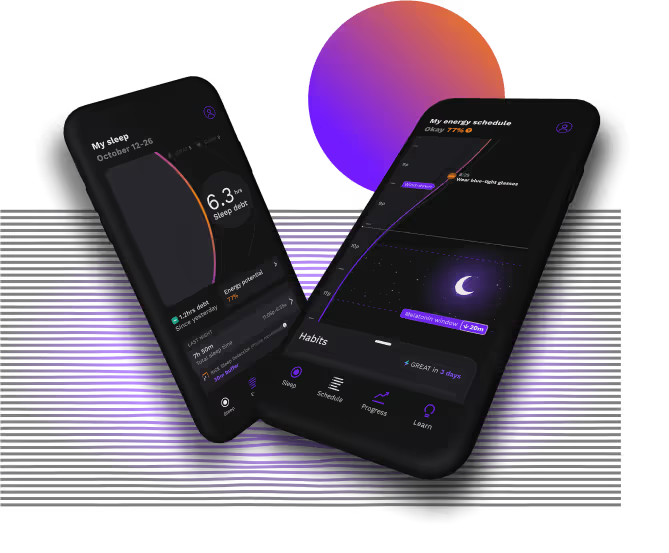
RISE makes it easy to improve your sleep and daily energy to reach your potential


No. A consumer tracker cannot diagnose sleep apnea, insomnia, or any other sleep disorder.
The American Academy of Sleep Medicine’s 2018 position is blunt. Consumer sleep technologies are not FDA-cleared medical devices. Clinicians should treat the data as patient-generated, not diagnostic. The device must not replace an evaluation.
Some wearables now flag snoring, breathing disturbances, or overnight oxygen dips. Those flags can be a reason to book an appointment. They are not a yes-or-no test. The latest Apple Watch and Samsung Galaxy Watch models can flag apnea risk and give you data to take to a clinician. They still cannot diagnose sleep apnea. If you snore, wake gasping, or stay exhausted after enough sleep, talk to your doctor. A home sleep apnea test or an in-lab study is the path that can actually answer the question.
No. A phone on the nightstand is enough for duration and timing.
Phone tap and unlock streams can recover sleep–wake timing compared with actigraphy. The useful measurement is the sleep–wake window: when you put the phone down, when you picked it up, and the quiet stretch in between. You can also use the microphone or the accelerometer if you want a second signal. We have written more about tracking sleep with just your phone.
A ring or watch can add overnight heart-rate trends if you already wear one. RISE can read those optional wearable nights from Apple Health or Health Connect. Hardware is not required for the number that matters, which is sleep against your own need.
Track sleep debt against your individual need, and whether you slept on your body clock. Skip the 0–100 sleep score.
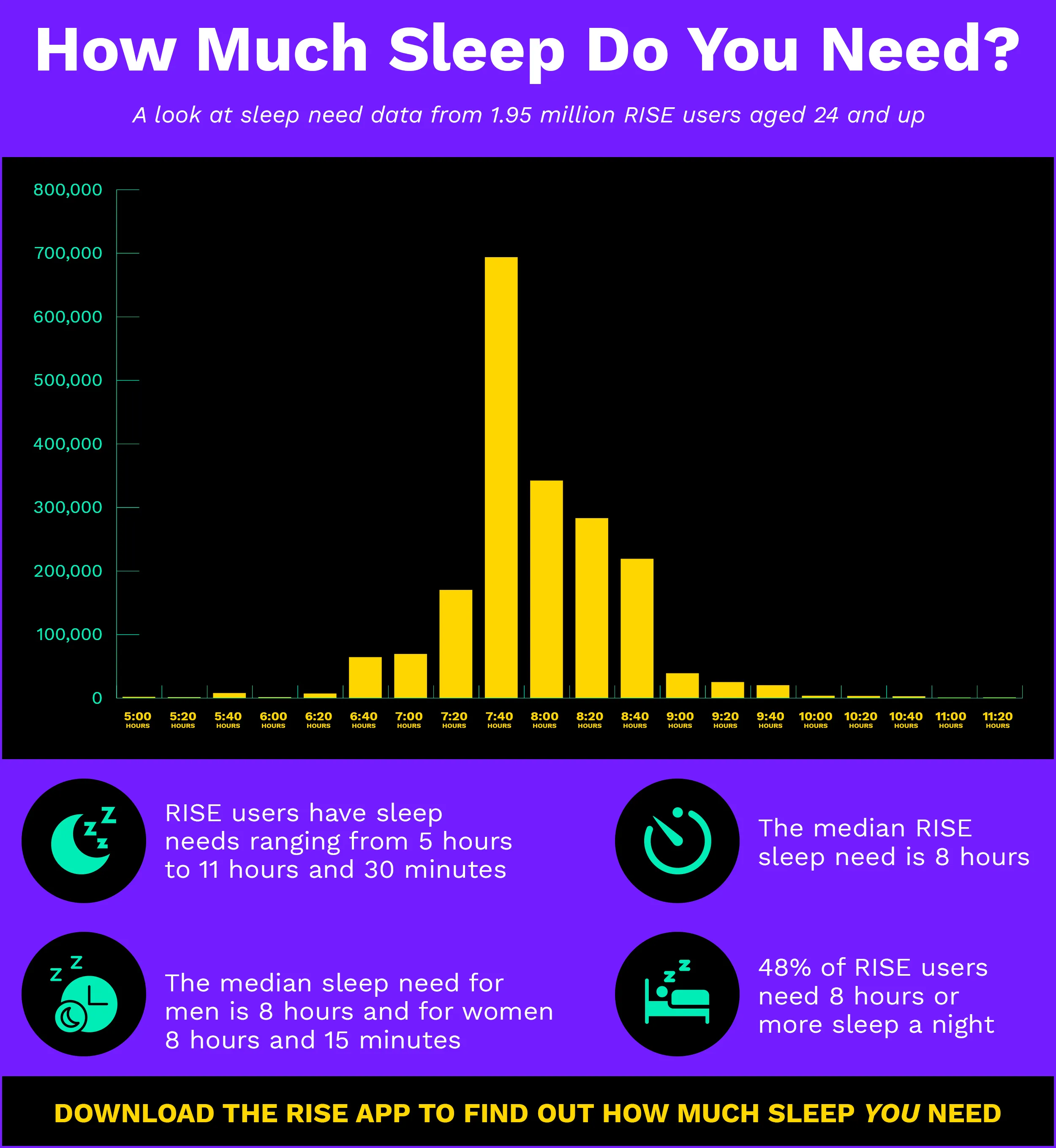
Looking at data from 1.95 million RISE users aged 24 and up, sleep needs range from five hours to 11 hours 30 minutes. The median is eight hours, and almost half of users need eight hours or more. A tracker that grades you against a generic eight-hour bar will call a nine-hour sleeper “overslept” and a six-hour sleeper “fine.” Both readings can be wrong.
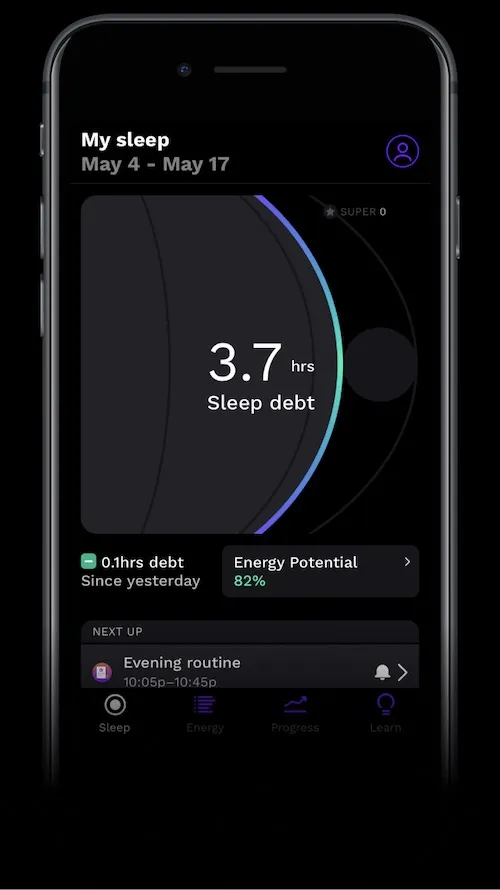
Sleep need is individual — a 2016 study found mean optimal duration around eight hours 25 minutes, with a spread of more than two hours between people. Debt is need minus sleep, rolled over recent nights. In RISE that window is 14 nights. That is the product method, stated openly. The science underneath is that extra wakefulness accumulates a neurobiological cost you do not fully feel in the moment.
A single quality score cannot carry that. Clinical “sleep quality” is a questionnaire construct — the Pittsburgh Sleep Quality Index — not a wearable 0–100. Chasing the grade can even backfire. Some people develop orthosomnia, an unhealthy fixation on getting the perfect night of data.
If you already own a wearable, keep wearing it for duration. Import the nights if you want. Then look at debt and circadian timing, not the stage bars. A smart alarm that claims to catch you in light sleep inherits the same stage problem, and it will not cancel sleep inertia. The useful wake tool is a window that respects your debt and your body clock. We have written the practical side in how to wake up to an alarm and in why you cannot wake up.
The RISE app is built around that pair. It estimates your need, tracks 14-night debt, and predicts your circadian timing — including a Melatonin Window for bedtime. It does not natively stage-track, and it does not issue a composite sleep score. That is the point, not a missing feature. For a candid look at cost and limits, see the RISE app review.
Sleep trackers work well enough for how long you slept and when. They do not reliably identify light, deep, or REM sleep against an overnight lab study. That gap usually does not matter for behavior. Paying down sleep debt and aligning with your body clock do not require stage labels.
No. Across recent lab comparisons, devices detect sleep versus wake at high sensitivity, but stage sensitivity often sits between about 50% and 86%. Agreement with polysomnography is only fair for most consumer bands. Treat REM and deep-sleep minutes as a sketch, not a measurement.
Phone apps can recover sleep–wake timing from taps, movement, or sound, and that is usually enough to see whether you are meeting your need. They inherit the same stage-accuracy problem if they try to label REM and deep sleep. An app is useful when it turns duration into sleep debt you can pay down.
No. The American Academy of Sleep Medicine says consumer sleep technology is not a medical device and must not replace evaluation. Snore audio, oxygen dips, or a “breathing disturbance” flag can be a reason to see a clinician. The latest Apple Watch and Samsung Galaxy Watch models can flag apnea risk. That is still not a diagnosis. Talk to your doctor if you snore, gasp, or stay sleepy after enough sleep.
No. Phone-use patterns can recover sleep–wake timing compared with actigraphy, and a phone on the nightstand is enough for duration trends. A ring or watch can add heart-rate trends if you already wear one. You do not need hardware to know whether you met your own sleep need.
The best tracker is the one that measures sleep against your individual need and helps you change bedtime, wake time, or a nap. A 0–100 score or a hypnogram is not that. Duration and timing are the most useful measurements. Stages are not reliable enough to steer a night.