
The RISE app is a sleep-debt and circadian coach, not a 0–100 sleep score. It costs $69.99 a year after a 7-day trial. It measures your sleep need, 14-night debt, and body-clock timing. It does not natively stage-track, and it is not a medical device.
This is a first-party review: Rise Science makes RISE. Wondering whether it’s worth the money? We’ve answered that separately in Is the RISE Sleep App Worth It?
RISE is $69.99 a year for Sleep and Energy Premium. That is $5.83 a month. There is a 7-day free trial on the yearly plan.
Monthly and Lifetime plans exist. Help-center copy names those tiers and does not publish the monthly or lifetime dollars on the page we use for this figure, so this review will not invent them. The public yearly number — $69.99 — is the one to compare against a ring membership or a watch.
You do not need hardware. That is the cost comparison most reviews skip. An Oura membership is $5.99 a month or $69.99 a year, plus a ring that starts at $349. WHOOP membership includes the band and starts at $199 a year. Apple Watch sleep features are free with the watch; the watch is not free. RISE is the app price, period.
Three things: your individual sleep need, your 14-night sleep debt, and the timing of your circadian rhythm.
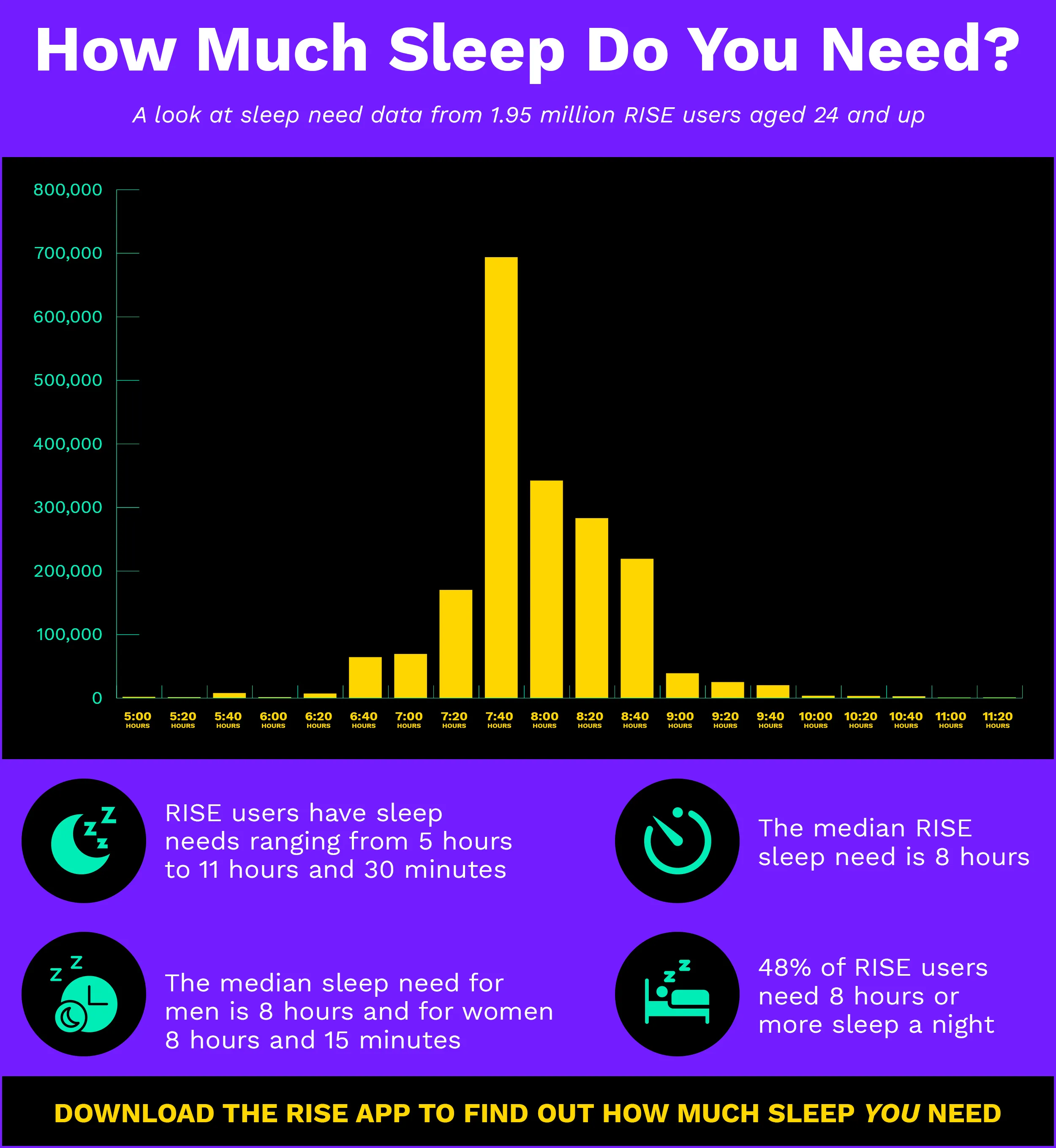
Sleep need is the hours of sleep you personally require. RISE estimates it from a year of phone-use behavior and sleep-science algorithms, not from a goal you typed in and not from a generic 7–9 hour band. Looking at data from 1.95 million RISE users aged 24 and up, sleep needs range from five hours to 11 hours 30 minutes. The median is eight hours. Almost half of users need eight hours or more.
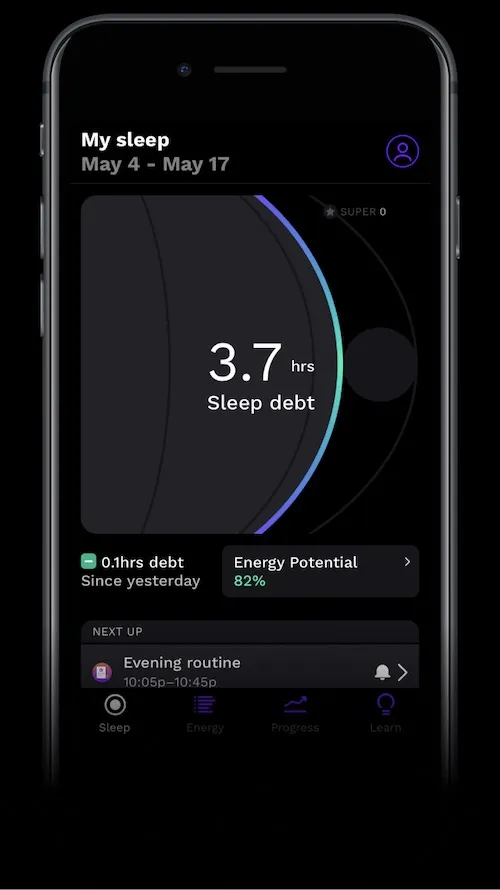
Sleep debt is that need minus the sleep you got, rolled over 14 nights. Last night carries about 15% of the weight. The previous 13 nights carry the rest, with recent nights counting more. You see one number, in hours — 3.2 hours of debt, not an 82. We recommend keeping it under five hours. Zero is the ideal and often not the week you are living.
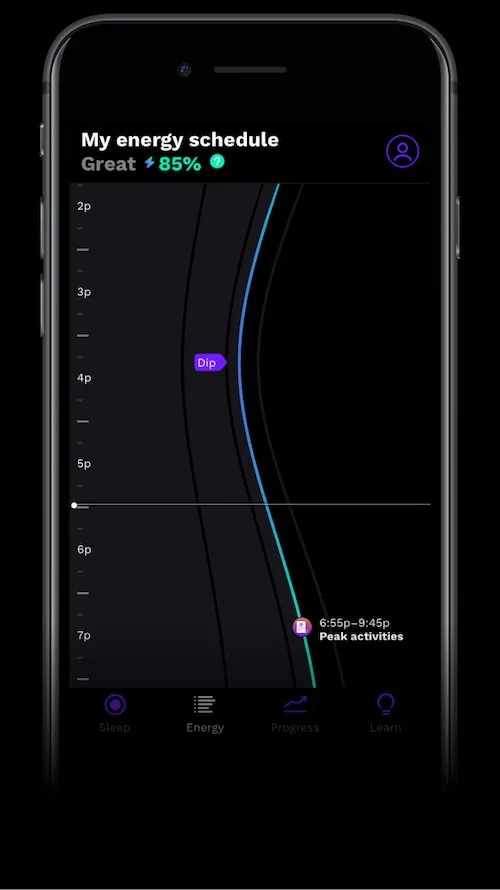
Circadian timing is the daily energy schedule. RISE predicts peaks, dips, a Melatonin Window for bedtime, and a morning wake zone. The model uses recent sleep times, inferred light exposure, and algorithms built on SAFTE, which was developed for the US Department of Transportation and the Department of Defense. You also get an Energy Potential score from 0 to 100. That one is a score. It is tied directly to sleep debt, not to estimated stages. If debt is the input, paying debt down is the only way the number moves.
RISE focuses on sleep need, 14-night sleep debt, and circadian timing. It leaves stage tracking to connected wearables and does not provide a composite score or diagnosis.
Sleep trackers work for duration and timing, but they do not reliably stage-track. A 0–100 grade that folds those stage estimates in does not tell you what to change tonight. Keeping both outputs off the home screen leaves it focused on two levers: get closer to your need, and sleep on your clock.
If you wear an Apple Watch, RISE can pull stage bars from Health and show them next to debt. The app does not compute those bars or ask you to chase them. It also does not record snoring, score strain, or replace a clinician. The 2018 AASM position on consumer sleep technology applies here the same way it applies to a ring: this is not a medical device.
| Compared | RISE | Oura Ring | WHOOP | Fitbit / Google Health |
|---|---|---|---|---|
| Focus | Behavior change — pay down sleep debt and align with your circadian rhythm | Hardware recovery ring — scores and readiness, not sleep-debt coaching | Strain and recovery wearable — additive with RISE, not either/or | Activity and sleep wearable — user-set sleep goal, not sleep-debt coaching |
| Price | $69.99/year (Sleep & Energy Premium). Monthly and Lifetime plans exist. | Membership $5.99/month or $69.99/year, plus ring hardware from $349 (Ring 4 Silver) | Membership includes the device: One $199/year, Peak $239/year, Life $359/year | Hardware plus optional Google Health Premium from $9.99/month. Charge 6 list $159.95 |
| Trial | 7 days free | First month of membership included for new members | 1-month Peak trial on certified pre-owned hardware; 30-day return | 3 months Google Health Premium on many new devices / accounts |
| Platform | iOS and Android | iOS and Android app + Oura Ring hardware | WHOOP band + iOS/Android app (no watch face) | Fitbit / Pixel Watch + Google Health app (iOS and Android) |
| Wearable required? | No — phone is enough; wearables optional | Yes — the ring is required | Yes — 24/7 strap | Yes — wrist tracker or Pixel Watch for automatic sleep and stages |
| What it measures | Sleep need, 14-night sleep debt, circadian timing (Melatonin Window) | Sleep stages, Sleep / Readiness / Activity scores, HR, temperature, SpO2, HRV | Sleep (stages, need, performance), Strain, Recovery, HR/HRV, respiratory rate | Duration, stages, Sleep Score, HR, HRV, SpO2; Premium adds coaching |
| Method | Phone-use models plus optional wearable/Health data; not a stage-scoring wearable | Finger PPG, temperature, accelerometer; Sleep Score from seven contributors | PPG + IMU, 24/7; Sleep Performance from sufficiency, consistency, efficiency, sleep stress | Wrist actigraphy + PPG staging; Sleep Score vs age/gender/time-in-bed targets |
| Data sources | On-device phone behavior; optional Apple Health / Health Connect wearables | Oura Ring sensors and the Oura app | WHOOP sensors; optional Apple Health write | Fitbit / Pixel Watch sensors and Google Health |
| Works with RISE? | This is RISE | Yes — Oura writes to Apple Health / Health Connect; RISE reads it | Yes — WHOOP → Apple Health / Health Connect → RISE | Yes — optional direct connection in RISE, and/or Apple Health / Health Connect |
Prices and features last verified 2026-08-18. Check each product’s site for the current figure.
Four ways, and the phone is enough for the first three.
If you forget the microphone, the mattress, or the watch, RISE falls back to tappigraphy so a night is not missing. Wear a tracker when you want the extra signal. Leave it off for a few days, or stop wearing one, and the 14-night window still fills from your phone. Switch from a Watch to a ring to a band later — RISE can keep using nights that land in Apple Health or Health Connect, plus the direct connections above. Microphone and movement tracking are currently iOS-only. Android still gets need, debt, and the energy schedule from phone use and any connected wearable.
On a typical morning the home screen is spare on purpose. You see last night’s sleep, the running debt number, and the energy curve for today. Open the alarm and it tells you, before you save, whether that wake time adds debt — a smart alarm aimed at debt and clock time, not a light-sleep guess. That is also the practical answer to how to wake up to an alarm and to why you cannot wake up: protect duration, then ride out sleep inertia. Open the habit list and you get 20-plus sleep-hygiene reminders timed to your clock — last caffeine, dim the lights, wind down — not a generic 9 p.m. blast.
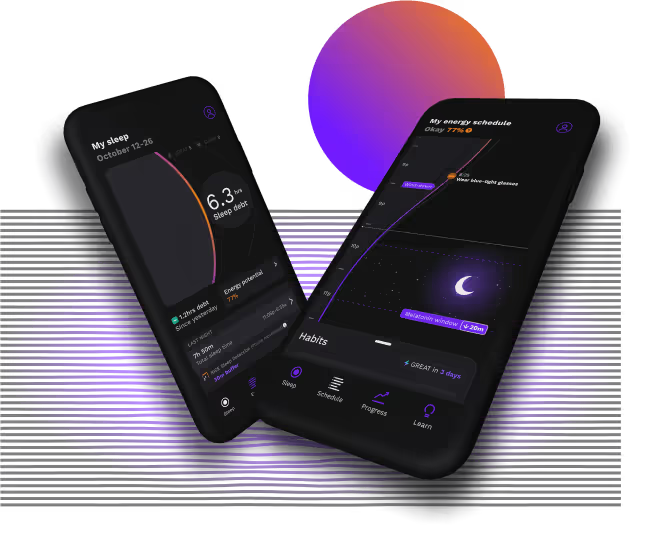
RISE makes it easy to improve your sleep and daily energy to reach your potential



RISE is for someone who wants a number they can act on tonight, and who does not need a new gadget to get it.
It is a fit if you keep asking “why am I tired after eight hours,” if your bedtime slides on weekends, or if you already wear a ring and still do not know what to change. The app’s job is to turn duration into debt and clock time into a schedule. Eighty percent of RISE users say they get better sleep within five days. That is a first-party figure, not a lab trial.
It is not for you if any of these is the actual product you wanted:
If you want a score, Oura or Fitbit is likely a better fit, and you can still import those nights into RISE for the debt math.
“The main problem I run into is people who get fixated or overly focused on things like their sleep score or the amount of each sleep stage they get, which we know is not reliable with most fitness trackers,” says Dr. Chester Wu, a double board-certified doctor in psychiatry and sleep medicine. RISE is the app built for that clinical complaint. It removes the noisy grade. It leaves the hours you can pay back.
Looking at data from 1.95 million RISE users aged 24 and up, sleep needs range from five hours to 11 hours 30 minutes. A self-set eight-hour goal will miss many people. We have also found that users with consistent sleep–wake times carry lower debt than users with inconsistent ones. That matches what a regular schedule should do, which is why the energy schedule and the smart alarm both push regularity rather than stage timing.
What we cannot publish yet is the distribution of debt itself — the median hours, the 90th percentile. Until that figure exists, treat “keep it under five hours” as the in-app target, not as a population statistic.
Use the trial during an ordinary week. Sleep at your usual times so the app sees a few ordinary nights. Then compare the need number with your running debt. Sounds, habits, and the gentle alarm are there to move those two.
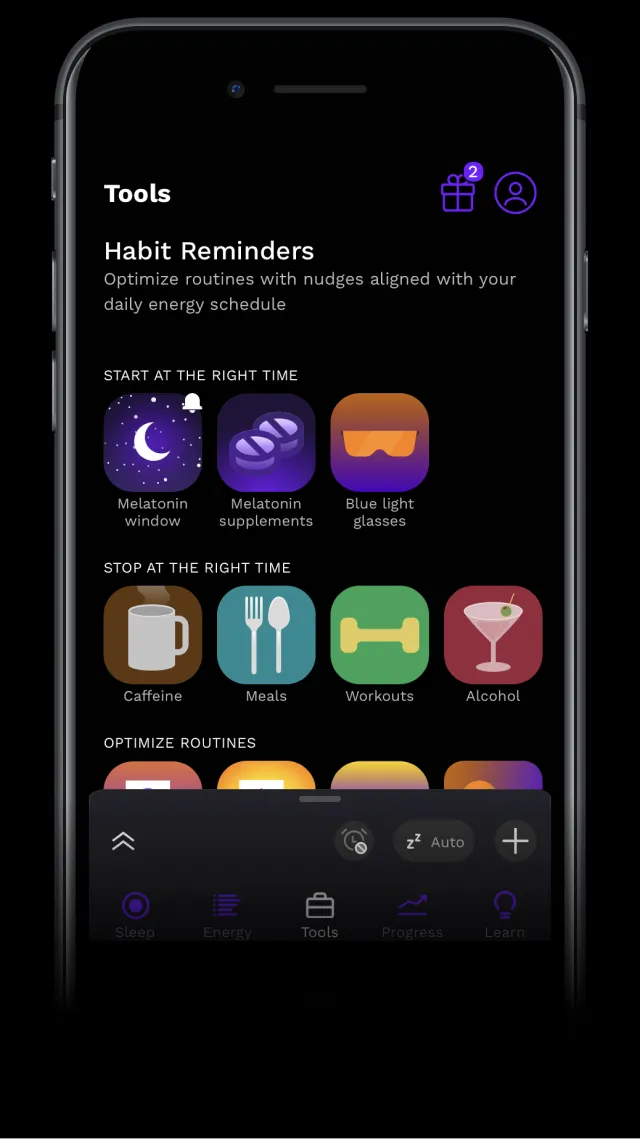
RISE is $69.99 a year for Sleep and Energy Premium, which works out to $5.83 a month. There is a 7-day free trial on the yearly plan. Monthly and Lifetime plans exist; the public yearly figure is the one to use. You do not need to buy a wearable for the app to work.
RISE estimates your individual sleep need, tracks 14-night sleep debt against that need, and predicts your circadian timing — including a Melatonin Window for bedtime and an energy schedule for the day. It then times sleep-hygiene reminders to that clock. It is a behavior-change coach, not a 0–100 sleep scorer.
No. RISE does not natively stage-track and it does not issue a composite sleep score. If you wear an Apple Watch, you can view imported stage data next to RISE’s debt number. Energy Potential is a 0–100 figure tied directly to sleep debt, not to estimated REM or deep sleep.
No. The phone is enough. RISE can use phone-use patterns, optional microphone tracking, or the phone’s accelerometer. Wearables are optional. Forget a Watch, ring, or band for a few nights and the 14-night window still fills from the phone. It can read Apple Watch, Oura, Fitbit, and Garmin directly, and, via Apple Health or Health Connect, devices such as Whoop. Switch wearables later and RISE can keep using whatever sleep lands in Health.
RISE is not for someone who wants a medical diagnosis, a free forever tracker, or a hypnogram as the product. It is not a strain or training wearable. If you want overnight HRV, snore audio, or an FDA-cleared test, you want a different device — and you may still pair that device with RISE.
It is worth it if you want a number you can act on — hours of sleep debt against your own need — and a clock for when to sleep, wake, and cut caffeine. It is not worth it if you wanted a gadget score or a sleep-stage report. There is a 7-day trial to see your need and debt before you pay.