

Paradoxical intention asks you to lie in bed and gently try to stay awake instead of trying to sleep. Removing the effort removes the performance anxiety that effort creates. A meta-analysis of 10 trials found large improvements against passive comparators and moderate ones against active treatments.
Paradoxical intention is a technique that flips the instruction: you get into bed, lie still in the dark, and your task is to stay quietly awake for as long as you can — while doing nothing to help yourself stay awake. No screen, no reading, no getting up. Just a gentle intention not to fall asleep.
It sounds like a trick and it is not one. The target is a specific problem: for a lot of people with insomnia, the trying itself has become the obstacle. Sleep is not something you can execute on demand, so effort applied to it turns into monitoring — am I drifting yet, how long has it been, how bad will tomorrow be — and monitoring is arousal. Take away the goal and you take away the way of failing at it.
In practice a clinician gives you something close to: get into bed at your usual time, turn the light off, lie comfortably, keep your eyes open as long as it is comfortable, and try to stay awake. If a thought about needing to sleep arrives, notice it and let the intention go back to staying awake.
What matters is the two things it rules out. You are not allowed to entertain yourself, because then it becomes a distraction technique rather than a removal of effort. And you are not trying hard to stay awake, because straining in the other direction is still straining. The instruction people find most useful is the framing: your job tonight is to rest, and whether you sleep is not your business.
Better than you would guess, on a thinner evidence base than the rest of CBT-I.
The first proper meta-analysis appeared in the Journal of Sleep Research in 2022 and pooled 10 trials. Against passive comparators such as waiting lists, paradoxical intention produced large improvements in key insomnia symptoms. Against active comparators — other real treatments — the improvements were smaller but still moderate on several central outcomes. The authors are careful in their own conclusion: the clinical improvements are marked, and methodologically stronger studies are needed before firmer conclusions can be drawn.
It also has older standing. The AASM's 2006 evidence review named five behavioral treatments with enough evidence behind them to be recommended, and paradoxical intention was one of them, alongside stimulus control, relaxation, sleep restriction, and CBT.
Because it removes something researchers can measure. They call it sleep effort, and there are questionnaires for it. In the same meta-analysis, paradoxical intention produced great reductions in sleep-related performance anxiety compared with passive comparators — which the authors flag as one of its proposed mechanisms of change rather than a proven pathway.
Sleep effort looks like a mechanism in the wider literature too. In older adults completing an online CBT course, changes in sleep effort mediated the improvement in insomnia severity. That does not prove paradoxical intention works through that route, but it puts the target on the map: effort is a thing that changes, and changing it tracks with getting better.
Resignation is a mood; paradoxical intention is an instruction with a shape. Giving up usually means staying in bed feeling defeated while still checking, which keeps every element the technique is designed to remove. The technique asks for something more specific and more neutral — hold a mild intention to stay awake, stay in bed, do nothing.
It is also not the same as the other things a clinician might tell you to do in bed, and those get confused constantly.
The contradiction resolves once you see what each one is aimed at: stimulus control says leave the bed, paradoxical intention says stay in it. They are aimed at different problems. If your bed has become a place you lie awake for hours, stimulus control. If you fall asleep fine on the sofa and tense up the moment you get into bed, the effort is the problem.
It sits at the edge of CBT-I. The AASM's 2021 guideline made recommendations on multicomponent CBT-I, brief therapies, stimulus control, sleep restriction, relaxation, and sleep hygiene. Paradoxical intention is not among them. That is an absence rather than a rejection — the guideline graded what it graded — but it means the technique has weaker guideline standing than the components in standard CBT-I, even with a positive meta-analysis behind it.
In a real course it usually turns up as a cognitive technique rather than a treatment of its own, aimed at the part of your insomnia that is about the fear of not sleeping. Which is also why it pairs naturally with work on sleep and anxiety. A sleep specialist can tell you whether effort is actually your problem, which is not a self-diagnosis worth attempting.
There is a broader point buried in a technique that works by removing effort. If monitoring your sleep raises arousal, then a nightly score to optimise is working against you — which is our position on sleep scores, arrived at from a different direction.
The two numbers worth attention are the ones you act on in the daytime rather than grade yourself against at night: your sleep debt and your circadian timing. Neither asks you to try harder in bed.
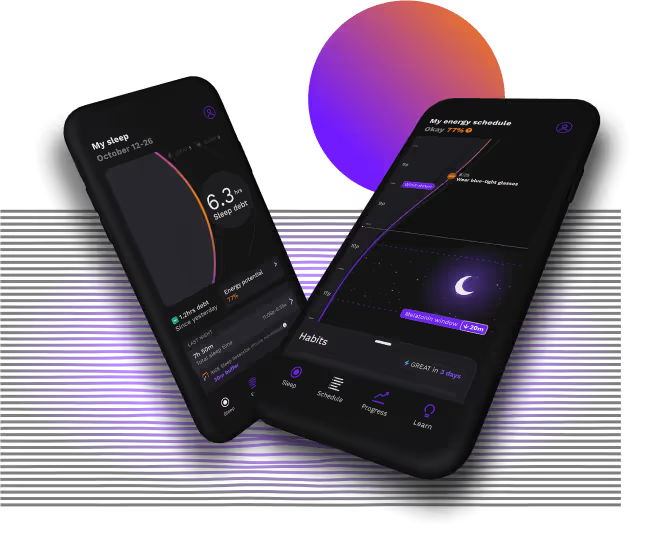
RISE makes it easy to improve your sleep and daily energy to reach your potential



The standard version: get into bed at your usual time, turn off the light, lie comfortably, and hold a gentle intention to stay awake as long as you can. No reading, no screen, no getting up. If a thought about needing sleep shows up, you notice it and return to the intention of staying awake.
Ask a clinician first if your insomnia is chronic, because whether effort is your actual problem is an assessment question. The technique itself is simple — stay in bed, try mildly to stay awake, do nothing to help yourself stay awake. What it rules out matters as much: no entertainment, and no straining in the other direction.
The evidence is positive and thin. A 2022 meta-analysis of 10 trials found large improvements against waiting lists and moderate ones against active treatments, and the authors say methodologically stronger studies are needed. The AASM's 2006 review counted it among the treatments with enough evidence behind them; its 2021 guideline did not make a recommendation on it either way.
No. Reverse psychology is about getting someone to do something by telling them not to. Paradoxical intention isn't trying to trick you into sleeping — it works by removing the effort and the self-monitoring that effort produces. If you were secretly trying to sleep the whole time, you would be doing the thing it exists to stop.
It depends which problem you have, and the two techniques genuinely conflict. Stimulus control says leave, because your bed has become associated with lying awake. Paradoxical intention says stay, because the trying is what is keeping you up. A clinician picks between them; guessing wrong wastes weeks.