

Usually, yes — insurance covers CBT-I when a licensed clinician delivers it, billed under your plan's mental health or behavioral health benefit rather than as a sleep product. That is the same benefit that covers other outpatient therapy. App-only programs with no clinician often are not. What you pay is set by your own plan.
Because a licensed clinician delivers it. CBT-I is a course of psychotherapy run by a licensed clinician — usually a psychologist with behavioral sleep medicine training — so it goes through the same benefit as any other outpatient therapy. That is the mechanical answer to the coverage question, and it is why "is CBT-I covered?" and "is therapy covered?" tend to have the same answer on a given plan.
It also helps that the guidelines are unambiguous about it being treatment. The American College of Physicians recommends CBT-I as the initial treatment for all adults with chronic insomnia disorder, and the American Academy of Sleep Medicine recommends multicomponent CBT-I for the same population. A treatment two specialty bodies name first is not a hard case to make to a benefits administrator.
Four things, and only one of them is about CBT-I. Nobody can tell you your own coverage from a web page — including this one — because these four are set plan by plan.
Whether CBT-I is a recognised treatment is not on that list, because that part is settled. The variables are all about delivery and administration.
RISE Sleep Clinic is in-network with Aetna, Anthem, Blue Cross Blue Shield, Medicare, and UnitedHealthcare, and with regional Blue Cross Blue Shield licensees, across a footprint of 39 states and Washington, D.C. The insurance page lists the payers and the states each one covers.
Being in-network is not the same as knowing your bill, and it would be dishonest to imply otherwise. Network status, benefits and out-of-pocket costs are verified with your plan before treatment begins — RISE checks your specific benefits with your insurer during intake and tells you your expected cost before treatment starts, because a figure quoted here may not be one your plan honors.
Two routes are worth asking about, and both are questions to put to your insurer.
The first is out-of-network reimbursement. If your plan has out-of-network behavioral health benefits, you may be able to pay the provider and submit a superbill — an itemized receipt with the diagnosis and service codes — for partial reimbursement. Whether your plan does that, and at what rate, is a question for your insurer.
The second is a tax-advantaged account. The IRS lists therapy provided by a licensed professional for a medical condition among deductible medical expenses in Publication 502, which is the same publication HSA and FSA administrators work from. Read the publication or ask your administrator rather than taking a blog's word for what your account will reimburse.
Usually not, when the app is the whole product. A self-guided program with no clinician is generally a consumer subscription rather than a billable service, which is the practical difference between the two routes even when both are delivering the same technique.
Which does not mean apps are a waste of money. A fully automated program reached 56.6% remission at one year in a randomized trial, and the VA publishes CBT-i Coach free to anyone. If cost is the binding constraint, a free app with published evidence is a serious option, not a consolation prize — see what a CBT-I app does and does not do.
The reason coverage matters more here than for most treatments is supply. A geographic survey counted 659 behavioral sleep medicine providers in the United States, and 105 of the 167 U.S. cities over 150,000 people had none. When the nearest trained provider is a video call away rather than a drive away, whether your plan covers a telehealth behavioral health visit stops being paperwork and becomes the whole question.
And the alternative has its own price. Medication is cheap per month and the ACP puts it second for a reason: in a placebo-controlled comparison, pharmacotherapy's gains returned toward baseline once the drug stopped, while CBT-I's remission held at 44% to 63% two years after a six-week course. A course you pay for once and a prescription you refill indefinitely are not the same purchase. The full comparison is on CBT-I vs sleeping pills.
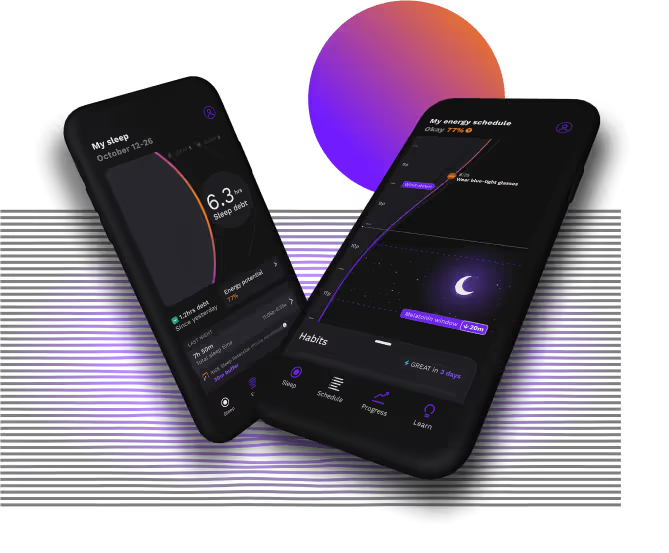
RISE makes it easy to improve your sleep and daily energy to reach your potential



Usually, when a licensed clinician delivers it. CBT-I is a course of psychotherapy, so it's billed under your plan's mental health or behavioral health benefit rather than as a sleep product. Self-guided apps with no clinician often aren't covered. Your own plan sets what you pay, so verify your benefits before starting.
Cognitive behavioral therapy generally falls under the mental health or behavioral health benefit, and CBT-I is billed the same way. Whether a specific course is covered still depends on your plan, your provider's network status, and who administers your behavioral health benefit — some plans carve it out to a separate administrator entirely.
Nothing. CBT-i Coach is published free by the U.S. Department of Veterans Affairs, carries no ads, and is available to anyone rather than only to veterans. It was designed as a companion to a course of therapy, and its randomized pilot studied it in patients who were already receiving CBT-I.
Yes. The VA's CBT-i Coach is free to everyone. If cost is what's stopping you, that matters: a fully automated CBT-I program with no therapist reached 56.6% remission at one year in a randomized trial of 303 adults, so a free option with published evidence is a serious starting point.
Weeks. The acute course in the trial behind the two-year remission figures ran six weeks, and shorter brief versions exist. Sleep efficiency usually shifts before daytime energy does. Knowing the course length is short is also useful for the coverage conversation, because you're asking about a defined number of visits rather than open-ended therapy.
That depends entirely on your plan, and it's one of the things worth confirming before you book. Some plans require a referral or prior authorization for behavioral health, others don't, and some route it through a separate administrator. Ask your insurer directly rather than assuming either way.