

Sleep anxiety is the loop where worrying about sleep becomes the thing preventing it. Bedtime turns into a performance with a scoreboard, and the vigilance that comes with a scoreboard is incompatible with falling asleep. It is a maintaining mechanism rather than a personality trait, which is why it can be treated.
It usually starts before you reach the bedroom. The dread turns up with the routine — brushing your teeth, setting the alarm, seeing the time — and by the time you are horizontal you are already braced.
Then in bed it has a texture people describe in remarkably consistent terms. A heart rate you can hear. Thoughts that will not slow down, and specifically thoughts about the sleep you are not getting. Arithmetic: if I fall asleep now I still get five and a half hours. Checking the clock and immediately regretting it. A body that feels wired and exhausted at once. And the particular cruelty of drifting off on the sofa at ten and being wide awake the moment you get into bed.
That last detail is the one to check in yourself. If the sofa works and the bed does not, your capacity for sleep is intact.
Because your nervous system has learned that bedtime is where something bad happens, and it is responding accordingly. Anxiety before an event you have repeatedly failed at is not a malfunction. It is the system working normally on a bad input.
Underneath that, insomnia researchers describe a state of elevated arousal that is not confined to the night. A review of the hyperarousal model found support across autonomic, neuroendocrine, neuroimmunological, electrophysiological, and neuroimaging studies for increased arousal in insomnia during both night and day. The same review names what keeps it running: dysfunctional sleep-related behavior, learned sleep-preventing associations, and cognitive factors like a tendency to worry and ruminate.
The physiology backs it up. Across 20 case-control studies, people with chronic insomnia showed moderately higher cortisol levels than good sleepers. So the feeling of being switched on at 11 p.m. is not imagined and it is not a failure of willpower.
In four steps, and every one of them is a reasonable response to the step before.
A run of bad nights makes sleep feel unreliable. Because it feels unreliable, you start protecting it — an earlier bedtime, a longer lie-in, a nap when the afternoon collapses, no plans on a work night. Each of those spends the sleep pressure you needed at bedtime, so you now lie awake longer with less drive to sleep. And lying awake longer gives you more time in bed to monitor, worry, and confirm that sleep is unreliable.
Which is why the interventions that work look counterintuitive. Protecting sleep harder is the move that tightens the loop.
They overlap, and the difference changes what helps.
Plenty of people have both, and one can turn into the other. General anxiety wrecks a few nights, the bad nights teach the bed a new meaning, and now there is a sleep-specific layer on top of the original problem. That is the common history.
It can, and it is not something you have to wait out.
The reason to take it seriously is that this runs in both directions. Anxiety disrupts sleep, and disrupted sleep worsens anxiety. There is a measure called sleep reactivity — how readily your sleep falls apart under stress — and in a study that followed 208 people from 2016 into the pandemic, higher pre-pandemic sleep reactivity predicted more stress reactions and more depressive symptoms three to four years later, with the odds of clinically significant distress over twice as high in the high-reactivity group.
Those participants had been randomised years earlier to digital CBT-I or to sleep education, and receiving CBT-I attenuated the link between sleep reactivity and later stress reactions. It did not attenuate the link with depression. So treating the sleep appears to buy some resilience, and it is not a treatment for everything.
Two things break it: removing the effort, and teaching your bed to mean sleep again. Those are the targets, and both of them have components of CBT-I built around them.
Stimulus control is the un-teaching one: get up when you are awake and frustrated rather than lying there, and the bed stops being somewhere you practise being awake. The AASM suggests it can be used as a single-component therapy for chronic insomnia. Paradoxical intention is the effort one — lying in bed gently trying to stay awake, which sounds absurd and produced large reductions in sleep-related performance anxiety against passive comparators in a meta-analysis of 10 trials.
For tonight, the ordinary tools are still worth having. Breathing exercises before bed target the physical arousal, and the AASM suggests relaxation therapy can be used on its own too. Turning the clock to face the wall removes the arithmetic. None of that resolves a loop that has been running for months, and it is not meant to.
Where insomnia sits alongside a psychiatric condition, the treatment still works: in a meta-analysis of 37 trials of comorbid insomnia, 36.0% of patients were in remission after CBT-I against 16.9% of controls. If your nights have been like this for three months or more, a sleep therapist can assess whether CBT-I fits. What you pay depends on your plan.
Melatonin is the wrong tool here, for a specific reason. It is a circadian signal — it tells your body what time it is — rather than a sedative or an anxiolytic. It has nothing to say to a nervous system that is aroused, which is why so many people find that melatonin does not work for them.
Melatonin has been trialled for anxiety, and where matters: the randomised evidence sits in surgical and oncology settings, in patients facing a procedure or treatment, not in people whose anxiety is about sleep. Reading across from one to the other is not supported. If your body clock is genuinely misaligned, melatonin is a reasonable conversation to have with your doctor. For the loop described on this page, it is not aimed at the problem.
The loop runs on a real quantity. Sleep pressure builds while you are awake and gets spent when you sleep, and it is the same thing sleep debt tracks. Every protective move — the early bedtime, the weekend lie-in, the recovery nap — spends pressure you needed at bedtime, which is precisely why the anxious response to a bad night makes the next one harder.
Timing is the other half. Going to bed early to catch up puts you in bed while your circadian rhythm is still running its wake signal, so you lie there alert with the lights off, which is the exact situation the loop feeds on. Keeping a steady rise time is duller advice than any technique and it does more.
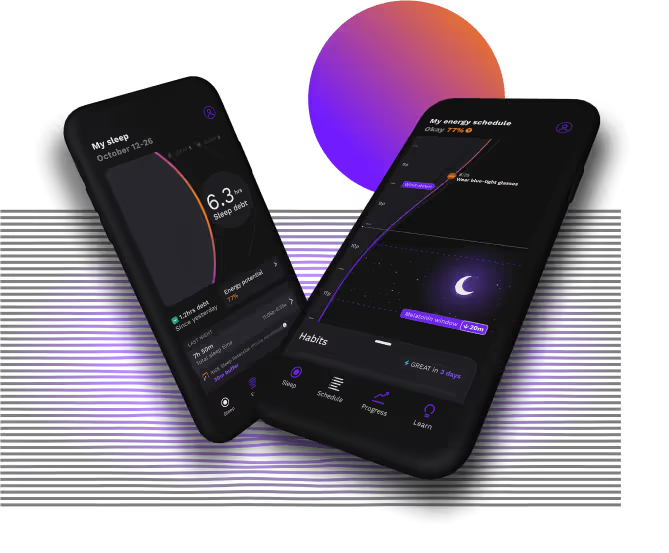
RISE makes it easy to improve your sleep and daily energy to reach your potential



Because your nervous system has learned that bedtime is where something unpleasant happens. Anxiety before an event you have repeatedly failed at is the system working normally on a bad input. Insomnia researchers describe elevated arousal running day and night, kept going by learned sleep-preventing associations and a tendency to worry.
A heart rate you can hear, racing thoughts, a body that feels wired and exhausted at once, and clock-checking followed by arithmetic about how many hours are left. With sleep anxiety specifically, the worry is about sleep itself, and the dread often arrives with the bedtime routine rather than once you are lying down.
It can, and treating it seems to matter beyond the sleep. In one study, people whose sleep fell apart more readily under stress reported more stress reactions and depressive symptoms three to four years later — and those who had received digital CBT-I years earlier showed a weakened link for stress reactions, though not for depression.
The two targets are the learned association and the effort. Getting out of bed when you are awake and frustrated is stimulus control, which the AASM suggests can treat chronic insomnia on its own. Paradoxical intention removes the trying. Breathing exercises help with arousal tonight but will not resolve a loop that has run for months.
Because the sofa carries no expectations and your bed has acquired some. On the sofa there is no performance to fail at, so the monitoring never starts. It is one of the clearest signs that the problem is the association around sleep rather than an inability to sleep, and it is the exact pattern stimulus control targets.
No — they overlap, but they name different things. Sleep anxiety describes the worry and the vigilance; insomnia is the clinical picture of trouble falling or staying asleep at least three nights a week for three months or longer, with daytime consequences. Sleep anxiety is one of the things that maintains chronic insomnia, which is why treating it is part of treating the insomnia.