

Trouble staying asleep has a clinical name — sleep-maintenance insomnia — once it runs three or more nights a week for three months with consequences during the day. The usual drivers are sleep pressure spent too early and a body clock out of alignment, plus arousal your bed has learned. Both major guidelines put CBT-I ahead of sleep aids.
Because falling asleep and staying asleep run on different margins. Getting to sleep needs one big push of sleep pressure at the right circadian moment. Staying asleep needs that pressure to still be doing work at 3 a.m., in the half of the night where your sleep is lightest and your cortisol is already climbing toward morning.
Three things eat into that margin. Sleep pressure gets spent early, usually by the sensible-looking responses to a bad night — an early bedtime, a long lie-in, an afternoon nap. Circadian timing drifts, so the back end of your night sits in a window where your body clock is pushing toward wake. And the bed picks up an association with being awake, which turns a brief, ordinary surfacing into forty minutes of lying there.
The last one is why the same wake-up can be a non-event for years and then become a problem. What changed is not the waking. It is what happens in the twenty seconds afterwards.
Same disorder, different presentation, and the distinction matters because it changes which part of treatment does the heavy lifting.
Plenty of people have both, and the labels are descriptions rather than separate diagnoses. What they buy you is a sense of which component to expect first from a clinician.
Some of it is just how nights work. In a telephone survey of 8,937 American adults, 35.5% reported waking at least three nights a week, and 23% woke at least once every night. Around 40% of the people with night wakings also reported other insomnia symptoms — which means most of them did not.
So the number of wake-ups is not the useful measure. The line sleep epidemiologists draw is whether you can resume sleep, and that is the one to apply to yourself. A wake-up you barely remember is part of a normal night. If you are reliably awake for half an hour afterwards, that is the thing worth treating. We have written separately about waking up in the middle of the night and the specific causes behind it.
The physiology of the second half explains the timing. Deep sleep is front-loaded, so what is left in the small hours is lighter and easier to surface from, and across 20 case-control studies people with chronic insomnia showed moderately higher cortisol than good sleepers. Waking is not the malfunction. Staying awake is.
This is the part most articles on the topic skip, and it is the one that makes the rest make sense.
Sleep pressure accumulates the whole time you are awake and gets spent while you sleep. A night that fragments in the second half is often a night that started with less pressure than it needed — because the day before it included a nap, or the morning before it included two extra hours in bed, or bedtime came an hour early in an attempt to catch up. Each of those is a reasonable response to feeling terrible, and each one reduces the drive holding your sleep together at 3 a.m.
That quantity is what sleep debt measures, and it is why the RISE approach and the CBT-I approach agree on the mechanism while pointing in opposite directions: debt tracking exists to keep pressure low over time, and sleep restriction deliberately drives it up for a few weeks so a fragmented night consolidates. Both rest on the same fact.
Two of the most common answers make the problem worse, and both are worth naming.
A drink before bed shortens the time it takes to fall asleep, which is exactly why people use it. In a three-night lab study it also reshaped sleep architecture and cut total REM sleep. For someone whose complaint is the second half of the night, a nightcap is targeting the wrong half. There is more on the timing in how long before bed to stop drinking.
Catch-up sleep is the other one. A nap or a long lie-in after a broken night spends the pressure that would have held the following night together, which is the loop this page is about. That is not an argument against ever recovering sleep — see whether you can catch up on sleep — it is an argument against doing it in the middle of a run of bad nights.
On prescription sleep aids, the guideline order is specific. The American College of Physicians recommends CBT-I as the initial treatment for all adults with chronic insomnia, and treats medication as a shared decision about short-term use after CBT-I alone has not worked. Zolpidem, zaleplon, and eszopiclone also carry an FDA boxed warning for complex sleep behaviors. That is a conversation for a prescriber, and not a reason to stop anything you are already taking.
The measure CBT-I moves most is the one this page is about. Across 20 randomized trials and 1,162 adults, wake after sleep onset improved by about 26 minutes — a larger effect than the 19 minutes it took off sleep latency. And in a trial that followed patients for two years after a six-week course, 44% to 63% were still in remission at 24 months.
Practically, that means a compressed sleep window to rebuild pressure, a fixed rise time, and getting out of bed when you are awake and frustrated rather than lying there teaching your bed the wrong lesson. The full shape of the program is on what CBT-I involves.
Untreated sleep apnea is the common reason none of it works, and it is a reason to be assessed rather than to try harder. If the pattern has held for three months or more, an insomnia therapist can tell you whether CBT-I fits and rule out what else might be waking you. What you pay depends on your plan.
If you take one thing from this page, take the fixed wake time. It anchors your circadian rhythm, which decides whether the back half of your night sits in a window your body clock supports, and it protects the sleep pressure you need the following night. Sleeping in after a fragmented night feels like the obvious repair and it is the move that reliably breaks the next one.
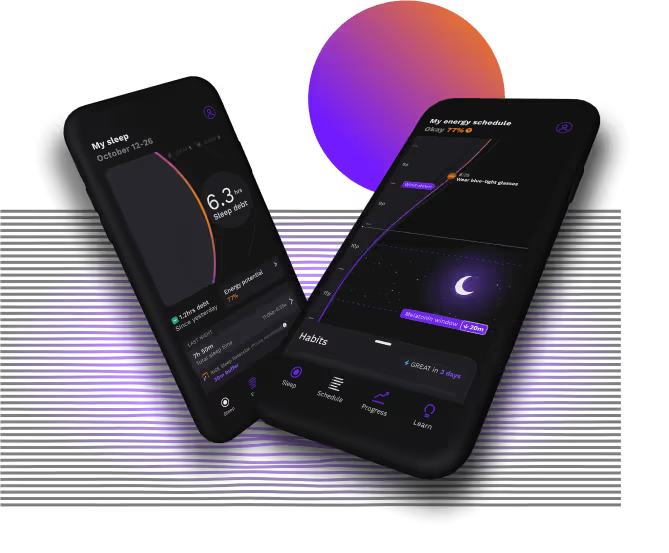
RISE makes it easy to improve your sleep and daily energy to reach your potential



Usually because sleep pressure has run low by the small hours, when your sleep is lightest and cortisol is already climbing toward morning. Naps, long lie-ins, and early bedtimes all spend that pressure early. If your bed has also picked up an association with being awake, a brief ordinary wake-up turns into forty minutes.
Waking is more normal than it feels. In a survey of 8,937 American adults, 35.5% woke at least three nights a week and 23% woke every night, and most of them had no other insomnia symptoms. What separates an ordinary awakening from a clinical one is whether you can resume sleep afterwards.
Nothing you can buy fixes the second half of the night well. Alcohol shortens sleep latency but reshaped sleep architecture and cut REM in a lab study, so a nightcap targets the wrong half. On prescriptions, the ACP puts CBT-I first and medication second, as a shared decision after CBT-I alone hasn't worked. Ask a prescriber.
Two hours in, you're usually coming out of your first deep-sleep block, so a brief surfacing there is ordinary. Waking that early and staying awake more often points at low sleep pressure at bedtime or a body clock that's out of step with your schedule. If it's happening most nights for months, that's worth assessing.
It's one presentation of it. Sleep-maintenance insomnia is trouble staying asleep at least three nights a week for three months or longer, with consequences during the day. Sleep-onset insomnia is the version where you lie awake at the start. They're descriptions of the same disorder rather than separate diagnoses, and many people have both.
If you're awake and frustrated, yes. That's stimulus control, which the AASM suggests can be used on its own for chronic insomnia. Go somewhere dim, do something dull, and go back when you feel sleepy. Lying there watching the clock is what teaches your bed to mean wakefulness.