

CBT-I online means several quite different products sold under one phrase. One is an automated program with no clinician. One is a prescription program a clinician orders. One is live video with a sleep psychologist. And one is a telehealth visit that ends in a sleeping-pill prescription, which is not CBT-I at all.
Pull the phrase apart before you buy anything. It covers products that differ in who treats you, what they deliver, and whether insurance touches them. Search for online insomnia treatment and the results mix all four.
The thing they have in common is delivery over the internet. The thing they do not have in common is whether a person is involved, and that turns out to be the variable the research keeps pointing at.
Five options. Row three is where a clinician-prescribed program sits, and the last one is not CBT-I at all.
The fourth row is not a criticism of telehealth prescribing, which is a legitimate service. It is a warning about the search results: a visit that produces a prescription is a different treatment from a course of CBT-I, and the guidelines put them in a specific order. If you want the head-to-head, we wrote it up on CBT-I vs sleeping pills.
Close enough that delivery method is not the deciding factor — though the two comparisons people blur are worth keeping apart. For therapist-led care over video versus in the room, a randomized noninferiority trial of 65 adults found telemedicine delivery not inferior to face-to-face on insomnia severity, at post-treatment and at three months, with similar therapeutic alliance. That is one trial, and "not inferior" is what it showed.
For software against a clinician, the evidence is separate. A meta-analysis of 11 randomized trials and 1,460 participants found internet-delivered CBT-I improved insomnia severity, sleep efficiency, sleep latency, subjective quality, and night wakings, with effects comparable to face-to-face care and generally maintained from 4 to 48 weeks — and within that same analysis, more personal clinical support tended toward larger effects. Both halves belong in the same breath.
The strongest single trial is worth stating in full, because it settles the "but is software really enough" question more honestly than any hedge. SHUTi, a six-week fully automated program with no therapist involved, was tested against online patient education in 303 adults with chronic insomnia, half of whom had a medical or psychiatric comorbidity. At one year, 56.6% met remission criteria and 69.7% were treatment responders. Every secondary sleep outcome favored the program except total sleep time — the exception that shows up everywhere in this literature.
Support comes in degrees, and that is the useful way to read it. It does not sort these options into better and worse — it tells you which variable to turn up if a first run does not move your nights.
Yes. The U.S. Department of Veterans Affairs publishes CBT-i Coach free, with no ads, and it is open to anyone rather than only to veterans. It was designed as a companion to a course of therapy — its randomized pilot enrolled only patients who were already receiving CBT-I — so using it alone stretches what it was built for. There is more on that distinction in what a CBT-I app does.
If cost is the binding constraint, a free program with published evidence is a serious option. Given a choice between a paid program you will not start and a free one you will, start.
Ask three questions and the field narrows fast.
Does it take a sleep diary and set you a sleep window that changes as your sleep consolidates? That is sleep restriction, and it is the component doing most of the work. Does it give you stimulus control instructions — the rules about getting out of bed — rather than a list of habits? The AASM suggests clinicians not use sleep hygiene as a single-component therapy, so a program whose whole offering is hygiene tips is not delivering the treatment. And is there a person available when the schedule gets hard in week two, which is when people quit?
One more that nothing online can do for you: no program screens you for sleep apnea, and untreated apnea is a common reason a sleep window stops working.
RISE spans rows three and four, and you do not pick between them blind. You complete one intake, a licensed clinician reads it, and they match you: a prescription for Sleepio on your own schedule, 1:1 video sessions with a sleep psychologist, or both. A licensed sleep psychologist is a video call away whenever you want to talk something through, and if the digital route alone is not moving your nights, that is the signal to add the clinician.
Naming the program matters here, because row three is the one people are most sceptical of. Sleepio is FDA-cleared to deliver CBT-I for insomnia, and it has been tested against a placebo: 76% of the digital-CBT group finished treatment with sleep efficiency above 80% — asleep for at least 80% of their time in bed — against 29% on a look-alike placebo program and 18% on usual care. Pooling three of its randomized trials in adults 65 and over, 60% reached remission against 16% of controls. It is a treatment a clinician prescribes after reading your intake, not an app you download and hope about.
The intake exists because the choice is a matching decision. Cost, how fast you need to start, whether weekly appointments fit your life, how much human contact you want, and whether something else needs a clinician watching it are all real inputs, and none of them is settled by ranking the formats. You can start with the RISE Sleep Clinic and let the intake do it. What you pay depends on your own plan, and benefits are verified before treatment starts.
To be precise about the other half of the product: the RISE consumer app is a behavioral sleep app, modelling your sleep debt and your circadian rhythm. That is the same pressure-and-timing machinery a sleep window works on, approached from the energy side. It is not itself CBT-I, and the clinic is where CBT-I lives.
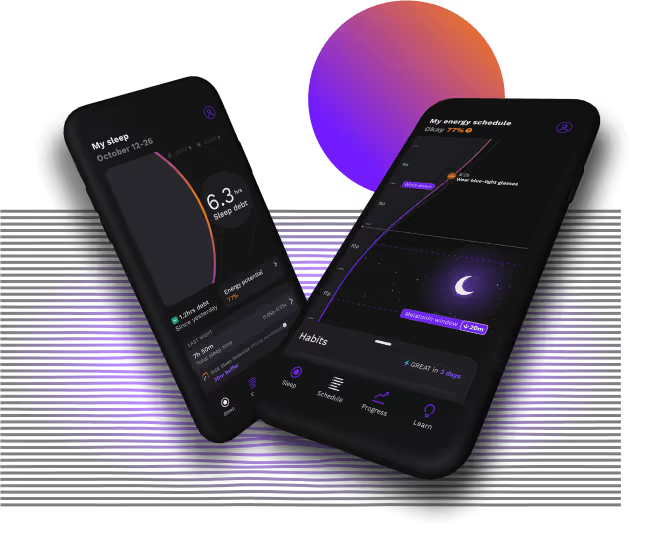
RISE makes it easy to improve your sleep and daily energy to reach your potential



Yes. The VA publishes CBT-i Coach free, with no ads, open to anyone rather than only veterans. It was built as a companion to therapy — its randomized pilot studied patients already in CBT-I — so using it alone is an adaptation. If cost is what's stopping you, a free program with published evidence is a real starting point.
For therapist-led care, a randomized noninferiority trial of 65 adults found video delivery not inferior to face-to-face on insomnia severity, at post-treatment and three months. Software versus a clinician is a separate question: across 11 trials, internet-delivered CBT-I produced comparable effects, with more personal support tending toward larger ones.
Yes, and one fully automated program reached 56.6% remission at one year in a randomized trial of 303 adults. The catch is week two, when a compressed sleep window makes you sleepier before it makes you better. Prescription digital CBT-I is the version that covers that gap — a clinician orders it after reviewing your intake, and there is a team to step up to.
Not always, and this is the thing to check. Some online insomnia services are a short telehealth visit that ends in a prescription, which is a different treatment with a different guideline position. CBT-I is a structured behavioral course with a sleep diary, an adjusting sleep window, and stimulus control rules.
When a licensed clinician delivers it, usually — it's billed under your plan's mental health or behavioral health benefit like other outpatient therapy. Automated programs with no clinician are generally a subscription rather than a billable service. Whether telehealth is covered the same way as in-person care is a plan-level question worth asking directly.
Check for two components. It should take a sleep diary and prescribe a sleep window that changes as your sleep consolidates, and it should give you stimulus control instructions about getting out of bed. If it's a checklist of sleep hygiene habits, that's the one component the AASM suggests clinicians not use on its own.